Wednesday, October 14, 2015

CycloMonkey's Weekend in the Valley

As a certain monkey makes friends and becomes more popular, it's nice to have a quiet weekend at home. But not this weekend. No. If you look at a map of California, there's a big emptiness between the ocean and the mountains. That's the Central Valley.

Almost Yosemite

With what seems like millions of other people, CycloMonkey, my wife and I hopped in the car and started driving towards that barren wasteland of nothingness that straddles Highway 99. Stop. Go. Stop again. 20mph. Stop. Big trucks. Less and less civilization. Less and less trees or even signs of life. Then uphill. Yes, this would make a nice bike route if there was a shoulder, fewer cars and cooler temperatures. Finally, we arrive at Oakhurst, California, at the intersection of Highway 49 and Highway 41.

Oakhurst is a gold-rush-era town on the southern edge of Yosemite National Park. We are here for two reasons:
1. The Yosemite Half Marathon, which my wife will run.
2. Ride #2 of my Coffeeneuring Challenge

Coffeeneuring features another anthropomorphized friend of mine: Mendo, the rubber ducky. As you might expect, CycloMonkey should avoid caffeine. So he is less than ideal for a partner in this. And with his recent surge in popularity, cannot be counted on to clear his calendar for these sedate little rides to coffee shops.

But he's rather unselfish and was happy to endure the long hours in the car. The first order of business, of course, is the half marathon. And that meant waking up before 4am so that my wife could catch the bus taking the runners up into the mountains for the start.

The upside of waking up well before dawn in a town with clear, mountain air and no smog, is the view of the planets aligned outside our hotel window!
The moon, Jupiter, Mars (faintly), Venus (bright) and Regulus (very faint) - taken with my cell phone!

Many of the establishments here are named Southgate Something due to the proximity of the south gate into Yosemite. And there are bears everywhere! Fortunately, the live bears hide up in the hills, so mostly there are just these carved, wooden bears that seem harmless.

I won't bore you with details of the race, the coffee or the hot, dry ride home. With Saturday in the books, we turned out attention to Sunday. Rest up, because we are heading back to the Central Valley again!

Bike Ride

At 6:30am on Sunday morning, CycloMonkey and I headed out in the cool, crisp air to meet our riding partners for the twelfth of my twelve consecutive monthy 200km randonneur rides. This ride would qualify me for the R-12 award. This would also be CycloMonkey's very first 200km ride - mostly due to my preference to carry food rather than monkeys in my limited number of pockets. But now I have a small bag for my top tube which freed up my middle jersey pocket. It's the perfect size for a limber and compressible monkey.

Since my jersey fabric wicks moisture away from my body, I worried about CycloMonkey absorbing said same moisture. So his "jersey" was a old plastic newspaper bag. One shot of espresso and we were off!

The streets were relatively quiet at 7am. CycloMonkey's view out the back consisted mostly of our familiar riding buddies. Will was there on the day CycloMonkey found us in Santa Cruz. Steven took CycloMonkey to Europe, so they're old friends. Bumha and Kenny would become old friends by the end of this long day.

The 200km "permanent" rides follow a predetermined route with specific control stops. The controls are usually spaced out about 30 miles apart or whenever it is convenient. The trip over the hills and into the Central Valley leave long gaps without much civilization, so the first control stop was about mile 45. By the second, at mile 61, we were almost halfway - time for a soothing creme soda.

Not frozen today.
Halfway would generally be a good time for lunch. But the control at roughly two-thirds is an oasis in the wilderness called The Junction. It is located where three roads meet: Del Puerto Canyon (our route from the Central Valley), San Antonio Valley (south to Mount Hamilton), and Mines Road (back to where we started). The little grill there serves beer and basic lunch food but it tastes awesome after many hours in the saddle. And you just can't there without spending many hours in the saddle. So we opted to skip lunch and head up the canyon.

From our control stop at the Patterson exit off Interstate 5, we headed west into the hottest, driest part of our ride. On my Garmin, I recorded 107 degrees (F). We went for miles and miles with very little shade or vegetation, slowly climbing. The road has huge numbers painted every mile, to aid airplanes in rescuing dehydrated cyclists. My memory has already faded in three days, but I believe around mile 18 or 19 is a natural spring. There is a small spigot of cold water (free!). Apparently, you'll get your daily requirement of magnesium from this water - but it tastes great.

A mile later, the climb got steeper, unrelenting for several more miles. But no bother, The Junction is right over the top! With the proverbial monkey on my back, I crested the summit before my compatriots. And I wanted the first beer. Somehow, I managed to hold off the chasers and arrived at the locked gate first! Wait, locked? Oh no! They are closed! I knew the owner had recently had surgery and was not keeping consistent hours - but how could this be!


Cheers on your accomplishment
Undeterred (because we had no other option), we carried on back to civilization. That meant about 30 more miles, however. Along the way, we hatched a plan to visit Altamont Beer Works in Livermore (thank you, Will).

Some may think that drinking beer during a long bike ride is crazy. I'd say "crazy refreshing!" CycloMonkey is of the opinion that it isn't wise. And he resisted. But as you can tell, there was plenty of cheering for CycloMonkey's first 200k. Well, it was rather hot. And he wasn't driving. And the "brown" was served with nitrogen instead of carbonization if that matters (looked cool, anyway). So he thoroughly enjoyed it. Perhaps the second was ill-advised.


Back in his newspaper bag and back out into the heat we went. Fortunately, the remaining few miles were flat and the headwind was minimal. Except for Bumha's flat tire, the day was a complete success.
Finally, we arrived back at the Starbuck's where we had started. This was also the finish control. One cookie for me, one cookie for CycloMonkey.

Personally, I'm rather tired. The day would end for me with slightly over 142 miles. But one of those last miles was a detour to drop off CycloMonkey at our friend John's house. Seems that John has a little surprise for which he wouldn't provide any details. Is it some exotic trip? Is it to meet a man in a yellow hat?

Curious?


Monday, October 12, 2015

Coffeeneuring Control Card


Verified and Validated Exclusively by Coffeeneurs USA

Checkpoint 1:_ Devout Coffee Arrival Time:
Address:______ 37323 Niles Blvd, Fremont, CA (24 Hr. format)
Open/Close:___ 07:00 / 09:00 08:30
Distance:_____ 29.8 miles Oct. 3, 2015
Checkpoint 2:_ The Cool Bean Cafe Arrival Time:
Address:______ 40120 Hwy 42, Oakhurst, CA (24 Hr. format)
Open/Close:___ 07:00 / 09:00 07:01
Distance:_____ 3.2 miles Oct. 10, 2015
Checkpoint 3:_ Panama Red Arrival Time:
Address:______ 2115 1st Street, Livermore, CA (24 Hr. format)
Open/Close:___ 07:00 / 09:00 08:07
Distance:_____ 20.7 miles Oct. 17, 2015
Checkpoint 4:_ Sunol Railway Cafe Arrival Time:
Address:______ 11882 Main St, Sunol, CA (24 Hr. format)
Open/Close:___ 07:00 / 09:00 08:10
Distance:_____ 15.6 miles Oct. 18, 2015
Checkpoint 5:_ Sugarie Bake Shop Arrival Time:
Address:______ 3500 Bernal Ave. #155, Pleasanton, CA (24 Hr. format)
Open/Close:___ 09:00 / 11:00 09:01
Distance:_____ 4.7 miles Oct. 24, 2015
Checkpoint 6:_ Pacific Bay Coffee Arrival Time:
Address:______ 1495 Newell Ave, Walnut Creek, CA (24 Hr. format)
Open/Close:___ 08:00 / 10:00 08:23
Distance:_____ 46.8 miles Oct. 31, 2015
Checkpoint 7:_ The Bubble Tree Cafe Arrival Time:
Address:______ 3120-B Santa Rita Rd., Pleasanton, CA (24 Hr. format)
Open/Close:___ 09:00 / 11:00 09:23
Distance:_____ 9.3 miles Nov. 1, 2015

CUSA Member #: 0654
Last Name:          Nelson
First Name:          Todd
RIDER's signature at FINISH: _____________________________________ 

This ride was done in: __5_ weeks, __7_ rides, __130.1_ miles.


Mendo's Coffeeneuring Challenge 2015 - Day 2

Take Two at the The Cool Bean


Fortunately, my inclination toward cycling challenges with arcane rules is well understood by my dear wife. She belongs to an asylum (web group for runners of half-marathons) who have criteria that would appeal to randonneurs. I list their disclaimer for your entertainment value.
The Half Fanatics will not be responsible for any of the above conditions incurred by you. Examples of these, but not limited to, the following actions:
  • On the verge or getting into financial ruin, including bankruptcy, by participating in so many marathons
  • Loss of a significant other, due to your addiction in this sport
  • Neglect of your residence (inside and outside, especially the yard) because of your constant absence due to participating in marathons
  • Any damage to personal property due (or property of others) when driving to and from events, especially when you’re tired and have to drive quite a distance to another marathon the day after you completed one (or the same day!)
  • Withdrawal symptoms when you can’t participate in events due to injury, special engagements, family functions, costs, etc.
And so I find myself supporting her at the Yosemite Half Marathon. If all goes well, next weekend will find her in two other states on Saturday and Sunday for two other half marathons and thus qualifying her for some new level of fanaticism. Aren't we a cute couple?

I am not a runner. So I brought my bike to look for coffee in this tiny town near Yosemite National Park.

### Coffeeneuring Control Stop #2 ###


DATE: 10/10/2015
DRINKS: Grounds for Change "Forestal" (Guatemala)
MILEAGE: 3.2 miles
COFFEE SHOP: The Cool Bean Cafe, 40120 Hwy 41, Oakhurst, CA

2nd Cup at The Pour Over Bar
BACKGROUND: The Cool Bean Cafe specializes in fairly traded, organic certified, shade grown coffee and direct trade, organic certified tea. You can select from a list of coffee origins at their pour over bar or have the baristas hand brew you an individual cup - see the last section. "Shade grown" was new to me, so I had to learn why coffee grown in the sun might be frowned upon.
Wikipedia: Coffee is a small tree or shrub that grows in the forest understory in its wild form. Sun-tolerant coffee plants were created to produce larger yields through higher-density, open planting, but the cultivation practices used for them are considered unsustainable and often have a negative impact on the environment.

Casey and Alyssa Lucas opened this shop in October of 2009. Casey grew up in the area and graduated from Yosemite High School. Alyssa grew up in Nebraska and then moved to California when she was young. They met in college and have been inseparable since!Apparently, not cyclists.

By the way, I also looked up the origin of the phrase "cool beans" and found nothing that I actually believe. Sorry.

COFFEE REVIEW: I walked in and said, "are you Casey?" and not surprisingly, the guy said "yes, I am Casey." "But not *that* Casey - Casey is the owner, but my name also happens to be Casey," he clarified. Okay Casey number two, what's brewing today? So Casey pointed me to the pot with a Guatemalan coffee called "Forestal" which is a single-origin, dark roast from a company called Grounds for Change. In addition to being fair trade, organic and carbon-free (well, carbon offset), they also participate in the Cafe Femenino Coffee Project in Peru, a co-op completely run by women and allowing them to take full control over the profits. Cool beans.

If you read my first post, you know I had a Guatemalan coffee last week. I'm barely educated enough to know dark from medium, so this is a total coincidence. And this also happens to be from the highland region of Huehuetenango. It was different than last week, but similar. Very smooth, rich but not overpowering. Clearly there was some hint of chocolate. Once he mentioned it, I could detect some smokiness.


I chatted more with Casey who asked, since I seemed like someone who really knew coffee (fooled him!), if I liked cold brew coffee. Never tried it. So he gave me an espresso-sized cup of some and I was very impressed. It was cold (no surprise), extremely smooth with no smokiness or "dirtiness" just really rich, complex flavor with no acidity. Fabulous.

FOOD PAIRING: I asked Casey, who clearly hadn’t given it much thought. But to his credit, he looked in the case and settled on some pumpkin bread. They bake it fresh. And I have to agree that it went very well with the dark roast.


BIKE AMBIANCE: Yelp has an item called "Bike Parking" and it said yes for The Cool Bean Cafe. The shop sits in a strip mall, but has an open patio. This morning, a pair of smokers were out there, so I sat inside. The fence around the patio was a nice place for the bike, so I’d give this place a “B” for bike ambiance. Not bad. As I was leaving, I chatted with the two old guys who were smoking and enjoying their coffee. My prejudice was broken when one said, “I used to have a Cannondale.” We chatted some more and they gave me some advice about navigating left across the busy street. Cool beans.

Moon over Denny's,
along with Jupiter, Mars, Venus and Regulus
DUCK'S VIEW: Mendo really looks good next to coffee, don't you think? Mendo thought the pour over bar was cool, he loved the copper. The bar, the food case, the busy behind-the-bar area was so "coffee shop" but the seating area was less interesting for a duck. The experience was comfortable, a little burbling fountain to float around in would be nice ...but then rubber duckies probably aren't the target demographic. This is more of a chainsaw-carved-bear sort of place.

THE BIKE: Soma, see the bottom of the "Day 1" post.

THE RIDE: Oakhurst is in the foothills next to Yosemite National Park. Our hotel and the coffee shop were on the same street and my ride was mostly downhill. I'm sure I pedaled, but not much. Afterwards, my task was to go retrieve my car from the local high school. My wife drove there are 4:30am to catch the bus taking the marathoners up the mountain so they could race back down. Not much of a ride. It was a classic Coffeeneuring ride, meaning it fulfilled its task of getting me some coffee - it's not about the bike.


TAKE TWO: I’m not sure if this counts as a double entendre, but this is Coffeeneuring Challenge ride number two, I talked with Casey number two and the coffee was so good that I went back later for a second cup. This time, I went with Casey’s suggestion for a medium roast pour-over from the Congo (I think, it might have been "Congolon" from Honduras now that I check their website). I was searching for the plum tones with a vanilla aftertaste but I wasn’t quite finding it. It was good and smooth, but I had a runner approaching the finish line and had to be there for her. Cool beans, take two.

Sunday, October 4, 2015

Mendo's Coffeeneuring Challenge 2015 - Day 1

Coffee somehow pairs well with cycling. I resisted it. For over 50 years I was one of those people who didn't drink coffee. But that changed as the alarm clock got reset to the five o'clock hour for commuting to work several times a week. First a half-cup. Then a couple cups. Then the search for a good cup.

I hadn't resisted beer. Beer pairs well with cycling, too. When porta-john's "Brewvet" beer and cycling challenge caught my eye, I was on-board. It was patterned loosely after the Coffeeneuring Challenge, which I had missed last year. But I was not going to miss it this year!

You might have questions about me, Mendo, my bikes. But your curiosity will have to wait (or scroll to the bottom, if you must). I have coffee shops to share!

Note that I actually trained for this Coffeeneuring Challenge. The night before the first ride, I drank perhaps more beer than necessary which makes coffee that much more than necessary.


### Coffeeneuring Control Stop #1 ###

Devout Coffee and Karma
DATE: 10/3/2015
DRINKS: Welser Hernandez (Guatamala) aka "black coffee"
MILEAGE: 29.8 miles
COFFEE SHOP: Devout Coffee, 37323 Niles Blvd, Fremont, CA


BACKGROUND: Brothers Jon and Stevie converted an old bbq into a coffee bean roaster and started making coffee in their garage. How Silicon Valley! In 2013, they opened this shop in the historic district of Niles. Jon made my coffee, today. We talked off and on - really nice guy. Cyclist.

COFFEE REVIEW: I asked for a recommendation, something black. The back of the menu had a dozen types of coffee that made no sense to me. Doing my best to fake my lack of knowledge, I picked the Guatamalean choice - Welser Hernandez.

I now know this probably came from the Highland Huehuetenango region. I remember one type of bean was Bourbon (the island, not the whiskey). The beans are sweeter with a sort of caramel quality, giving the coffee a nice, crisp acidity, but can present different flavors depending on where they’re planted (I copied that). Whatever a "high-quality cup" means, I'd agree. It was light, but flavorful and very well finished (if I'm using that term correctly). Another reference used the phrase "the peanut-butter-and-jelly of the coffee world". Full disclosure: I also spent over 50 years as one of those people who didn't eat peanut butter. Off-track now.

FOOD PAIRING: I had a cronut. It was great, but perhaps the flavor was too strong for the slightly more delicate Welser. Frankly, I think the pretzel thingy would have been, too. Did I miss the vegan apple donut? That seems about right. Next time.

Devout also sells Tcho chocolate - and you can have your mocha made with Tcho. Coincidentally, Tcho was a chocolate start-up in San Francisco. I heard about it in the beta stage and was one of their beta testers. I had some of the version 0.9 dark chocolate before it had a name. I'd like to think I influenced the stuff they call "chocolatey". How Silicon Valley!

BIKE AMBIANCE: I leaned my bike against the front of the building where I could see it. Turned out there was a bar stool right there, so it felt like fate. Jon told me there is a patio along the side and plenty of room for bikes there - but no windows (so he doesn't feel good parking his own bike there). Bust through the wall and put some patio doors and some windows and it would be perfect.

As a cyclist, I felt very much at home. Jon and I talked about bike rides and visiting other coffee shops - which he does. Apparently, he's not competitive with other shops; he just loves coffee and wants to learn more about it. He immediately grasped the coolness of Coffeeneuring, so I sent him the link to the Challenge. Overall, I highly recommend Devout Coffee for cyclists.

DUCK'S VIEW: Mendo loved the decor. The tables and bar were heavy reclaimed wood, very substantial. It was manly, not many flowers (but some, or were they cacti?) All the equipment was visible as was the espresso machine and it had a feeling like Buffalo Bill's Brewery - somewhat industrial but in an old world way if that makes any sense. It's dog-friendly, too, which is not so great if you're a duck. Even a rubber ducky.

THE BIKE: Soma, see the bottom of the post.


THE RIDE: Let's take the ride in four symmetric parts. First, I stopped at the ATM near my house and headed toward Sunol in brisk, clear 51-degree sunrise. Pleasanton to Sunol is part of my normal commute, so I took a parallel path on Foothill. Uneventful. Cool. Second part, from Sunol to Niles along Niles Canyon is rather sketchy. In places, the shoulder is less than a foot and visibility for cars is poor and the cars and trucks treat this road as a highway. There are two bridges: one over the old railroad tracks and another over the arroyo (sorry, that's Alameda Creek, in Spanish it was Arroyo de la Alameda).

When the Transcontinental Railway was built connecting this great land of ours, it ran through this very canyon. There's a significant hill between Pleasanton and Niles (the Niles district of Fremont) and the railroad goes through a tunnel at some point. The road doesn't have a tunnel, but is a really gorgeous, winding road through the rugged canyon.

Part four actually followed my commute route from Sunol to Pleasanton along the appropriately named Pleasanton-Sunol Road (which may actually be called Sunol-Pleasanton Road in this direction). Recently, we've been dodging some road gators, extension cords and pieces of lumber. So I decided I'd ride along and get them off the shoulder. Seemed nice. By the last one, I was tired of stopping and figured I'm good enough to simply coast by with one foot unclipped and kick it. I unclipped my right shoe but then changed my mind. Did I mention that I *always* unclip the left shoe first? Like a noobie, I fell over - right into the street. Fortunately, no one hit me! For my ego's sake, no one saw me either. And because you'll ask, my bike was fine. Even my brand new shiny Giro helmet was scratch-free. But a half-mile down the road, I realized my Garmin was not there. I found it. Fortunately, no one ran over it.

Which leads me to my theme.

KARMA: No, I'm not going to say that my good deed of cleaning the roadside annoyed the Universe and unceremoniously dumped me on the pavement. That wasn't it. After stopping by my house to pick up my backpack, I went to the Farmer's Market in Pleasanton. I stuffed my backpack with stone fruit and tomatoes, then got a brownie (do farmers make brownies?). As I was munching on my brownie, I realized I didn't have my wallet. Yikes! I scurried back to the Lone Oak Ranch fruit stand and caught Dale's eye (the owner). He said "Todd?" - he previously didn't know my name. He had spotted my wallet and pulled it behind the counter, not knowing how to reach me. Good guy, that Dale. Karma.

Apropos of nothing, Dale is famous for saying, "tastes like squirrel."


About Me: 
I still consider myself a novice at most things: cycling, coffee, blogging, and an imposter at many other things: engineering, etc. I love cycling for the scenery and the serenity but also for the occasional intensity. The fact that it affords me endless eating and drinking opportunities is a side benefit. I'm in my fifties, so I've got a few more years to shake off the "novice" moniker.

Home is Pleasanton, CA and the cycling opportunities are year-round, hilly and scenic. I'm lucky. 

About Mendo:
Mendo is a little rubber ducky that I bought as a souvenir in Mendocino many, many years ago. If you read my other blog posts, you'll read about a stuffed animal called CycloMonkey. He's rather popular and my friends often take him on trips. So I decided Mendo would be consistently around and could brighten up my photographs and become memorable. Mendocino is a cold, damp beach town in northern California and seemed like a good place for people who like coffee. So that's why I picked him. There's no deeper meaning than that.

Vote for me in the "Most Clever Use of Tub Toys" category.

About My Bikes:
I've got a few bikes, but only two that I ride consistently. There are two Treks in partial states of disassembly and a 1970s Louison Bobet (French, of course). But I need one more bike :)
Volagi Liscio is my primary road bike. There's quite a story with the founders defecting from Specialized to build a double-century kind of bike for older riders. It has disk brakes way before they started to become popular (well, they still haven't). It has SRAM components and is otherwise configured like most road bikes. I can ride it all day and climb mountains and feel great! Gloss black with bright red and bits of white.
Soma Fabrications' Wolverine is my other bike. I had it built especially for Coffeeneuring. It technically is a cross frame, but I run regular 25mm roadie tires. It is a single-speed, so no need for shifting while I might have a hot cup of coffee in my hand. It is belt-drive (no chain) in case I spill. I use the same brand of hybrid-hydraulic disk brakes as my Volagi, because I like them that much - not because they aid in coffee consumption. And it has bull-horn bars so the brake handles are easily accessible and there's also more places to rest a cup. It's cro-moly steel with a custom fork (because I thought the standard one didn't live up to the "Wolverine" name). The ride is fabulous and the gearing I chose can get me up to 22mph without drafting or descending. Turns out, I can muscle up a 5% hill - but not with coffee in my hand!

Thursday, October 1, 2015

Hydreco and My Dad

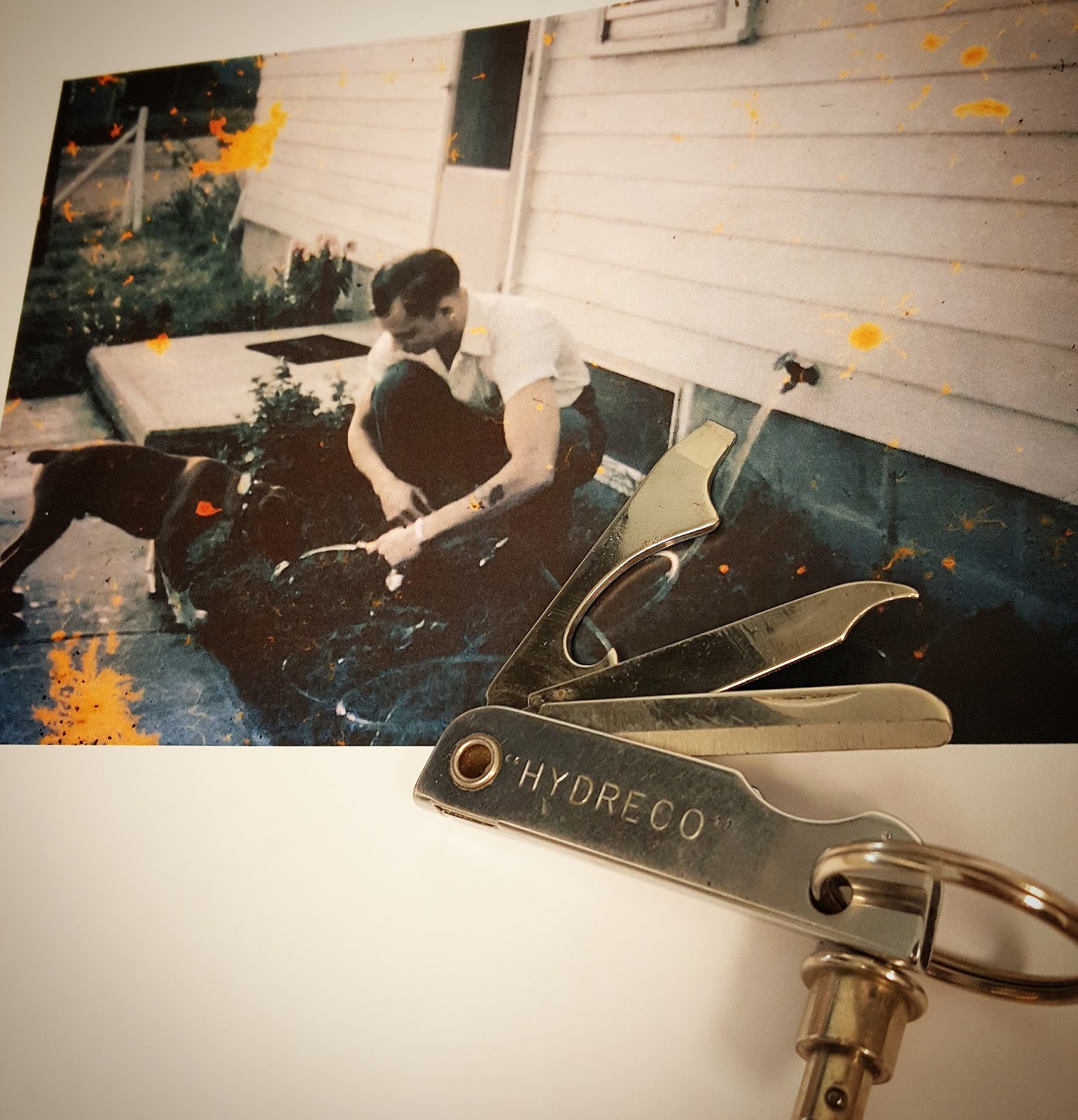
I have a combination nail file, bottle opener, knife with “HYDRECO” engraved on it – quotes included. I keep stuff like this. It’s on a ring with a detachable keyring that is long since gone. Hydreco is the company where my dad worked for many years while I was growing up. They made big, heavy hydraulic pumps and valves for industrial use and my dad was a machinist.

Near as I can tell, Hydreco goes back to the 1930s as the Hydraulic Equipment Company. There have been so many mergers and acquisitions that the lineage is rather foggy. There is some association with Hamworthy Engineering, David Brown Group, Allied Signal and Clyde Blowers throughout the years. How they came to my hometown is difficult to find. It’s only slightly clearer how my family came to my hometown.

Before Hydreco, I have a vague recollection of my dad working at Eckrich (Armour-Eckrich Meats, founded in Fort Wayne, IN), more of a fond olfactory memory of smoky links. We lived in Portage at the time, a new suburb of Kalamazoo, MI. We had a brand new house on Capri Street. Down the street was a guy named Al Yingling and apparently his wife watched my brother and me while my mom was at work at Upjohn’s (The Upjohn Company, fascinating history). Al got my dad the job at Hydreco. At Eckrich, dad had a friend named Joe Gizmundo. I remember Joe as an architect with a really cool house built into a hillside. My parents wanted more land; they were not cut out for suburbia. Joe found the farmland property that became the home I grew up in, which happened to be less than a mile from Hydreco.

Dad’s 1967 Chevrolet Truck

Dad drove an old 1967 half-ton Chevy pickup to work. It had a straight six, three-on-the-tree, highway mirrors and a full-length, fleetside bed. A V-8, shortbed C/10 would be classic today, but not this one. I don’t think he bought it new – that seems like the last thing he would ever do (especially a truck). But he must have purchased it fairly new with low miles. He only drove it to work and back, hunting, hauling, etc. I don’t recall ever seeing him wash it. He would change the oil about once a year on principle – not based on mileage. That was the only time it was ever in the garage.

Visiting Dad at Work

There were several times that I went inside Hydreco to visit. It was a magical, mysterious experience for a bashful, clean-cut kid. It took a minute for your eyes to adjust to the darkness. It was cavernous with impossibly high ceilings with huge buckets of dank yellow light hanging from conduit amid the overhead conveyors. The smell hit you right away and then you could see the green cloud through the whole place. The smell and the fog came from the pea-green lubricant that sprayed as the mills and drills created the pumps and valves from raw castings. The lubricant served to carry away the metal shavings and keep the cutting tips cool. It’s an unmistakable smell and conjures up this very image still today. Much like high-octane exhaust fumes, it’s nauseating but a happy memory.

The floor was concrete but dirty with metal filings and rubber left from the fork lift wheels. Danger was everywhere. Clearly this was no place for kids. Men would stare and sometimes taunt. Then they would recognize my dad and say something only mildly reassuring. The constant hum of the machines would muffle the voices and even the warning buzzers that went off randomly. The explicit posters by toolboxes reminded me that this was a place for men. No smocks, no hard hats, just metal grating to protect you from flying debris. Of course, nothing about this scene could exist today.

My dad would be assigned to one machine or another, working on this pump or that. The pea-green Goliath of a machine seemed 10-feet tall, had conveyors going in and out, and must have weighed many tons. The partially tooled pumps would queue up on one side and finished ones were crated on a pallet on the other side awaiting a fork lift. Dad’s job was to interpret the drawing, set up the machine, calibrate everything to within thousandths of an inch and work out the simplistic automation (mostly lights and buttons, no fancy robotics in those days). There was some standard rate assumed and I seem to recall that dad frequently hit 300% of quota. And I recall dad having massive forearms and bit meaty hands. Steel-toed boots, jeans and a white T-shirt – no uniform.

Perception of Engineers

The uniform, if you call it that, belonged to the engineers. They wore the short-sleeved, white shirt with the thin black tie and pocket-protector. They sat in the offices at the front of the building and entered through the double-doors up front by the flagpole. The workers entered from the side, near the loading dock. I really have no idea what the engineers did at Hydreco, but they formed my first impression of engineering. With the benefit of decades of hindsight, I presume they designed the pumps and managed the transition from design to actual manufacturing as well as specifying the manufacturing equipment.
To the machinists, the engineers were a bit of a joke. They may have been educated, but they didn’t “know” things. The machinists would explain things to the engineers when they ventured out from the air-conditioned cleanliness of their offices with their pea-green metal desks and vendor-logo ash trays. Some machinists knew the necessary equations and other just simply had the feel, but they could have designed these pumps themselves. They lived with the pumps for eight hours a day, fixed the machines, perfected the manufacturing flow and put up with the condescending tone from the detached engineers.

Moving to Georgia for Cheaper Labor

Sometime in the late 1970s, the higher-ups at Hydreco decided to move the facility to somewhere in Georgia – presumably for cheaper labor. At least that’s how it filtered down to me. My dad’s factory was a union shop and I’m sure the one in Georgia had to be, also. But it must have made financial sense. It’s just business. Long before jobs were sent off-shore for cheaper labor in other countries, there was a migration to other parts of the United States for the same reason. Leaving the same void in the community and resentment toward that other place. However, Hydreco was not a huge part of the economy for my hometown and the disruption wasn’t that significant. Not even in our own house. My mom always worked. Dad did what he could until he landed another job. That’s another story.

Craftsmanship and Building Everything from Raw Material

Hydreco built hydraulic pumps and valves. Somewhere else, raw iron was cast and these casting were shipped to our factory for machining and assembly. In that sense, it was not quite raw materials in and finished goods out but close. And dad brought that sensibility home with him. He didn’t buy what he could make and he didn’t pay someone else to do something that he could do. He had more time than money. We had piles of angle iron, pipes, bar stock, gears and random chunks of steel out back. Dad had a band saw, arc welder, acetylene torch, drill press, a lathe and enough tools to fill a professional garage. We had two garages. Come to think of it, we built that second garage ourselves. That’s yet another story.

And Craftsman wasn’t just the name on the toolbox. Even with the benefit of decades of hindsight, my dad was really good with tools and took great pride in his work. It seemed like he could do anything. He tried to teach me, but I could never be as good as him. Today, I appreciate a good bead from a good welder. I look at the joints in exposed woodwork. Drips in paint. Cover-ups. My dad is my benchmark for good craftsmanship. Made in U.S.A.
He may have learned that at Hydreco. Maybe there was some informal apprenticeship that occurred with some older craftsman there. Maybe it was in the Navy. Maybe it was his dad. He never really said. It was just the way things should be done. It mattered.

I use the nail file, bottle opener, knife combo tool occasionally. It’s a physical reminder of Hydreco. And it’s a gateway to all those other memories. The smell of that coolant. The belief that I could build anything or fix anything if I had to (fortunately, I don’t). The sense of a craft and of craftsmanship. Hydreco taught me a little about the relationship between the workers and the thinkers; and the need for humility in my own career.

I probably wouldn’t forget all this if I didn’t keep this stuff. But I keep stuff like this.

NOTES:

https://www.hydreco.com/about-us/our-history (Poole, England website)

http://en.hydreco.fi/our-history (Finland website)

Monday, September 14, 2015

Bicycles, Quadricycles the Early Men of the Motor City

I grew up in Michigan and was thoroughly immersed in the automotive industry and its history. Not cycling; that came later. The hallowed ground of Speedway, IN, - the brickyard, the Indy 500 – was a few hours’ drive to the south. Any history that really mattered was housed a few hours’ drive to the east in Dearborn, MI – The Henry Ford Museum and Greenfield Village. I knew that both AC Spark Plug (aka ACDelco, a division of General Motors) and Champion Spark Plug were started by Albert Champion. I knew that from the four founders of the Indianapolis Motor Speedway (Fisher, Wheeler, Allison and Newby), that Fisher started Fisher Body and Allison started Allison Transmission (also both divisions of General Motors) and made helicopter engines. I knew that Barney Oldfield drove Henry Ford’s No. 999 and basically helped Henry start his Ford Motor Company. I knew that Louis Chevrolet was Swiss – not French, the Dodge Brothers worked for Ransom E. Olds (your father’s Oldsmobile) and Ford, and that the Duryea brothers built cars before any of them – but they weren’t from Detroit (the Motor City), so you’ve probably never heard of those two. Yes, I knew a bit of history.

So let me tell you “the rest of the story” as Paul Harvey used to say.

Albert Champion


Born near the Arc de Triomphe in Paris in 1878, Champion was actually a bicycle courier as a kid and became a professional cyclist at 18 years old – specializing in track racing (velodromes) and motopacing (speed records while drafting). He was only 5’7”, which was ideal for paced racing behind tandems, triplets, and ultimately motorcycles. Parisian journalist Victor Breyer nicknamed him “petit prodige” (little marvel). He was a very successful cyclist in those types of events but had never raced in the types of road races we commonly see today like the Tour de France. Paris–Roubaix is a famous one-day road race that is even older, having started in 1896. Called “the Hell of the North”, Paris–Roubaix is known for its cobblestone sectors, and is very hard on cyclists. In 1899, trying to expand its popularity, the organizers allowed motorcycles for pacing (barely faster than bicycles in those days). Thus many track specialists entered the race; what advantage they may have had from experience in paced races, they lost in inexperience on the cobbles and other bad road surfaces. Champion, now 21, was an outsider but the others chased when he broke away soon after the start. Only one competitor could come close to catching him, getting to within a minute at half distance. Champion slowed through hunger near the end, riding the worst of the cobbles at walking speed, but at the velodrome in Roubaix he still had a lead of 23 minutes. Champion finished in 8:22:53, the champion of Paris–Roubaix.

His win came as a surprise to many and increased his popularity. Champion went to America after his win to profit from track racing contracts. Around then, Champion had opened a factory to make spark plugs. After retiring from cycling, he went on to pursue his interests in automobile racing and in business. "He had contracted the car virus", said the historian Pascal Sergent.

Carl Fisher

I knew of Carl Fisher from a famous photo of the four founders of the Indianapolis Motor Speedway along with Henry Ford. Until the mid 1980s, most GM cars had “Body by Fisher” on the door sill – that’s also Carl Fisher. I didn’t know that Carl Fisher was crazy, though. Well, maybe not crazy, but a highly energetic huckster like P. T. Barnum. Fisher became wealthy as a result of his partnership with James Allison in the Prest-o-lite company, making headlights for early automobiles. Fisher creatively promoted a plan for a highway spanning the country from New York City to California. He estimated the highway would cost $10 million to build and sought pledges from the automobile executives and – except for the notoriously cheap Henry Ford – managed to get the project funded. This became the Lincoln Highway with Fisher as vice president.

As the Lincoln Highway progressed, Fisher had an idea for a winter get-away for his automotive buddies. He started a massive project improving a jungle of swampland in Florida that came to be known as Miami Beach. Amazing. And how would Midwesterners get there? Fisher, the “father of the Lincoln Highway,” used his promotional talents to create another highway: the Dixie Highway. Quite impressive: Prest-o-lite, Fisher Body, the Indianapolis Motor Speedway, the Lincoln Highway, the Dixie Highway and Miami Beach. And, of course, you know what else? He was a cyclist!

Fisher quit school when he was 12. By 17, he and his two brothers opened a bicycle shop in Indianapolis where they repaired flat tires for just 25 cents. Fisher managed to be in the right place at the right time as the bicycle craze swept the country. He would ride in the Indianapolis Zig-Zag Cycling Club’s rides to distant cities. Joining Fisher on those rides were James Allison and Arthur Newby, future founders along with Frank Wheeler of the Indianapolis Motor Speedway.

Local journalist and poet William Herschel of the Indianapolis News noted that Fisher was nicknamed “Crip” (short for cripple) by his bicycling buddies “because he frequently, in bursts of speed, took a spill and ended with many bruises and cuts.” Although handicapped by poor eyesight, Fisher managed to compete in bicycle races, battling with the likes of champion racer Barney Oldfield. Fisher convinced George Erland, a leading Ohio bicycle manufacturer, to supply him with $50,000 worth of merchandise on credit. Ever the huckster and short on cash, Fisher performed stunts to promote his store. Wearing a padded suit, he rode a bicycle across a tightrope stretched over Washington Street; he built and rode a 20-foot-high bicycle; and he released a thousand toy balloons, 100 of which contained tickets for a free bicycle. His wife said that he “owned the finest bicycle shop in all of Indiana” at the age of 19. By the turn of the century, he became enamored with the newly invented automobile. Fisher told Oldfield, “I don’t see why the automobile can’t be made to do everything the bicycle has done.”

Albert Newby

You already know that one of Fisher’s partners in the Indianapolis Motor Speedway was Albert Newby. I’ll bet you didn’t know that the Zig Zag Cycling Club of Indianapolis was co-founded by Newby. He was ahead of the game in cycling. Newby was working as head bookkeeper at Nordyke and Marmon in Indianapolis (later the Marmon Motor Company and, yes, the makers of the “Marmon Wasp” which was driven to victory in the first Indianapolis 500 by Ray Harroun) when he decided to turn his love of cycling into a business.
Together with Glenn G. Howe and Edward C. Fletcher, they formed the Indianapolis Chain & Stamping Co. which manufactured Diamond bicycle chains. At this time, all the bike chains were being made in Europe, but Newby’s chains quickly gained over 60% of the American bicycle chain market. By the way, Orville and Wilbur Wright were Diamond chain distributors when they were bicycle mechanics in Dayton. The first airplane used a Diamond chain.

Newby wasn’t the huckster that Carl Fisher was, but he convinced the League of American Wheelmen to hold their National Meet in Indianapolis – comparable to the NCAA Final Four or the Super Bowl today. What he needed, of course, was a track! To that end, he built the Newby Oval in 1898 — one of the fastest bicycle tracks in the country at a cost of $23,000. The track had electric lighting and seats enough for 20,000 spectators. It was a quarter-mile white-pine board velodrome (four laps to the mile, in the lingo of the day). The track lured some of the best racers in the country like "Plugger Bill” Martin, Tom Cooper and a 15-year-old named Marshall "Major" Taylor. Have you heard of him?


One source credits Newby with creating the hugely popular six-day bicycle races that still boggle my mind. But according to Peter Nye, the six-day races were not Newby’s idea. Perhaps he brought them to Indianapolis, though. In America, it was with the Madison Square Garden six-day races that created the boom. And it was Tom Eck who promoted the first Garden Six, in 1891. But Newby did eventually become president of the National Motor Vehicle Company in Indianapolis – not Detroit – so I’ve never heard of it.

Henry Ford

Henry Ford needs no introduction, but he was not the first to make a car and cruise the streets of Detroit. Just as thousands still cruise Woodward Avenue to this day, at just after 11pm on March 6th, 1896 the very first automobile rumbled past crowds of onlookers. This car was driven by its builder, 28-year-old mechanical engineer Charles Brady King. He was followed by a tall, slim man on a bicycle: Henry Ford. Three months after riding behind King, Ford went for a cruise in his first automobile. Ford’s Quadricycle featured many bicycle parts: a tubular steel chassis, 28-inch bicycle wheels and pneumatic tires. There is so much written about Ford after this point, some quite troubling, but little about his love of bicycles.

Ford sold his car to his friend Charles G. Annesley for $200. (Trivia: Annesley sold the Quadricycle to A. W. Hall, a bicycle shop owner.) Annesley, like Ford, was a cyclist. Ford worked for Thomas Edison’s company as a mechanic; he was neither a bicycle mechanic nor a racer but he always rode bicycles. Ford rode to work at one of Detroit’s Edison electric plants on his bicycle. Ford also cycled to work when he was developing the Model N, precursor to the Model T of 1908. He may be known now as the father of the US auto industry but he was careful with his money and knew that his trusty bicycle could get through Detroit quicker than the town’s trams. Throughout his life, Ford remained a cyclist. Time Magazine, in August 1940, reported that on his birthday, the 77-year-old automotive billionaire “took a ride …on the light (12-lb.) English bicycle on which he likes to take a three-mile spin every evening after supper."

Barney Oldfield

Henry Ford built cars for the masses, but before that he also built a few race cars. One of the more brutally powerful cars was the famous Number 999, named after a record setting New York Central train. Purportedly, the engine had cylinders the size of gun powder kegs and developed close to 100 horsepower – about eight times that of a conventional car. “The roar of those cylinders alone was enough to half kill a man!” Ford once said. Ford had driven his 999 for himself in a race or two, but soon decided that he felt safer just making the cars. The racing scared the life out of Ford who compared it to going over Niagara Falls in a barrel. He declined to pilot it in the Manufacturers Challenge Cup. He needed someone else with sheer grit and daring to drive his car and 24 year old Barney Oldfield was the man for the job. After seeing the 999 for the first time, Oldfield told Ford, "But I've never driven a car." Inexperienced as he was, Oldfield is rumored to have learned the controls of the car the morning of his first race, and by the end of the day he had defeated what was thought to be the world's fastest car, the Winton bullet. This launched both of their careers.

Soon Barney Oldfield was a household name and was racing cars all over the country, setting speed records left and right. Oldfield was the first ever to drive around a mile track in less than a minute (1903). This was four years after “Mile-a-Minute” Murphy accomplished the same speed on a bicycle – drafting behind a locomotive on a specially boarded section of railway – by the way. But I digress; let’s get back to Barney.

His early life was very hard. He quit school at 12 and began work as a water boy on a construction crew, and moonlighted as a bellhop. He was fascinated with speed and taken up by the bicycle craze. The lightweight bicycles used by racers were still too expensive for him. However, he soon discovered that a tenant of the Monticello Hotel had a lightweight bicycle, and stored it in the hotel basement. Each night, Oldfield "borrowed" it from its unsuspecting owner, and sped through the dark streets of Toledo. According to William Nolan in the Toledo Blade, Oldfield told his parents, "Someday I'll own the fastest cycle in the whole wide world. People will come from a thousand miles away just to watch me ride it!" At age 16, in 1894, he entered his first bicycle race and won; his prize was a $25 diamond ring, which he pawned to finance his next race. Soon, the Dauntless bicycle factory asked him to ride for them in the Ohio state championship. Although Oldfield came in second in the race, he secured a job and was soon being paid handsomely by the Stearns bicycle factory in Syracuse, New York to race on its amateur team. When he won his next race, he sold his gold medal back to the promoter for cash. Oldfield was a large, strong professional bicycle racer. After an unsuccessful venture in coal mining in Colorado, he resumed his bicycle racing career in Salt Lake City, UT. He became associated with fellow racer Tom Cooper who was Henry Ford’s partner in the Number 999 (and had also declined to drive it!). So Tom suggested to Henry that Barney could drive it. And now you know the rest of that story, too.

Louis Chevrolet

Baseball, hot dogs, apple pie and Chevrolet. Do you remember that song? How about the red, white and blue USA-1 license plates that symbolized Chevy in the 1970s (before the gas crisis)? Chevrolet epitomized America, sounded French but was the name of a Swiss car guy. I assume you are way ahead of me and expect to hear about his love of bicycles. How smart you are!

As you do when you are Swiss, Louis' father Joseph worked in the watch industry, but Louis learned to repair and later race bicycles. He would eventually build and sell his own bicycle called the Frontenac. Louis not only raced, but he won numerous races on Darracq bicycles. He was a husky teenager and became a champion bicycle racer after he tailored bicycle gear ratios to take advantage of his strength. At some point he was given a job at the Mors and Darracq Company. Darracq built the well known Gladiator bicycles, however Louis was intoxicated by the Darracq internal combustion engine. This diversion would end his cycling career, prompt him to move to Montreal and ultimately Detroit. Bye, bye miss American pie.

Horace and John Dodge

Thanks to the recent Dodge television commercials, you probably think you know the Dodge brothers.

Horace Elgin Dodge and John Francis Dodge were young cyclists and in 1897, with Canadian Fred Evans, founded the Evans and Dodge bicycle business. Their bicycles were based on a dirt-resistant ball-bearing assembly the brothers had patented the year before. “Mr. Dodge” was a stoker in a two-mile tandem race on the Detroit banked track in 1897 and the brothers were active members of the Detroit Wheelmen, volunteering to be race judges and timers. (Forgive my name-dropping, but Horace also worked part-time for Henry M. Leland making high-precision parts for the bicycle industry. Leland started the Cadillac Motor Car Company in 1903.) The Dodge brothers dissolved the partnership with Fred Evans in 1900 and used their share of the proceeds to establish their own machine shop in Detroit, making parts for the fledgling automobile industry. Contracts to supply to Ransom Olds, maker of the Oldsmobile, and the Ford Motor Company made the brothers’ firm into one America’s biggest auto-parts suppliers. From 1903 until 1914, the Dodge brothers supplied about 60 percent of the total value of the cars that Ford built. After that, they branched out on their own, becoming the competitive pair portrayed on those television commercials.

Well into the period when they were making fortunes from the automobile business the Dodge brothers were still active in cycling. In 1905, John Dodge ran for a position on the Detroit Wheelmen board and Horace was elected the club’s second vice-president the following year. Ford might have been Detroit’s most famous cyclist but the Dodge brothers were better.

Charles and Frank Duryea

After graduating from high school in 1882, Charles Duryea became a mechanic and entered the flourishing business of bicycle repairs, one of the greatest 'growth sectors' of the 1880s and 1890s. He built a high wheel bicycle in his teens. His brother, Frank Duryea, was several years younger, but did much the same. They moved often and in different directions. Both worked in Washington D.C. in a bicycle shop briefly before splitting up again. At one time Peoria, IL, was one of the largest manufacturing centers for bicycles in the United States. Charles moved to Peoria and started a business with Geo W. Rouse to produce a brand of ladies bicycles called the Sylph. Rouse, Hazard & Co manufactured 7,500 bicycles in 1896. The Peoria Rubber and Manufacturing Company manufactured 10,000 bicycles and 25,000 pairs of bicycle tires annually; they sold out to the American Bicycle Company. The Patee Bicycle Company made over 5,000 bicycles annually. The Ide Mfg. Company made 2,000 bicycles annually as did Luthy & Co. But this isn’t about Peoria; it’s about the Duryea brothers. Later, Charles was contracted to build bicycles for a firm in Rockaway, NJ, along with his brother Frank. Ultimately in 1893, they moved to Springfield, MA, and got distracted by internal combustion engines and started the first automobile company in America. It featured parts from a Columbia tricycle bought from the Pope Manufacturing Company. One of their automobiles was bought by Henry Wells of New York. On May 30th, 1896 Wells drove his Duryea Motor Wagon into New York City to take part in a horseless-carriage race organized by Cosmopolitan magazine. While racing, on public roads, he crashed into Evelyn Thomas, riding a Columbia bicycle on Broadway near West 74th Street. Wells became the first motorist arrested for what would later become known as “dangerous driving". Apparently, they also built the first car to sputter along Washington’s Pennsylvania Avenue. It was somewhat of a circus freak, literally (and appropriately), leading out a parade by Barnum & Bailey’s Greatest Show on Earth in 1896. The car was upstaged by eight baby elephants and a gorilla called Joanna.

Early Sylph bicycle
The Duryea brothers may have been immortalized for their automobile, but Charles remained a cyclist. He was a member of the League of American Wheelmen. He wrote in the club magazine, “From the dawn of history to the present, civilization and roadways have been linked together. Whether landways or waterways, whether traversed by ships or slaves, canal-boats or camels, canoes or cyclers, the progress of any country has been reflected by its system of roads.”


And with that comment, I suggest you read “Roads Were Not Built For Cars” by Carlton Reid.

And Now You Know

The rest of the story doesn’t stop there. The connection between cycling speed freaks and bike mechanics who became pioneers in the automotive industry goes way beyond Detroit. In fact, this whole theme is even stronger in Europe. Cycling carried on in Europe and maintained the people’s interest, unlike America where cycling almost died as cars took over. Cycling became so unimportant that history failed to mention these connections. Today, bicycles and cars seem to be polar opposites; they seem antagonistic toward each other. Yet they are so closely related, different branches of the same tree. Riders on the same road.


NOTES

http://www.theautopartsshop.com/carchronology/early-days-of-duryea-brothers.html
http://genealogytrails.com/ill/peoria/biz/EarlyManufacturers.htm
http://www.thewheelmen.org/forum/topic.asp?TOPIC_ID=7549
“Albert Champion: The little marvel” By Peter Joffre Nye, Published Aug. 15, 2015
http://velonews.competitor.com/2015/08/news/road/albert-champion-the-little-marvel_381413
“The Hoosier Barnum: Carl G. Fisher”, by IHS staff
http://www.indianahistory.org/our-collections/reference/notable-hoosiers/carl-fisher#.VfCslqRVhBc
http://archive.indystar.com/article/99999999/NEWS06/80508055/Carl-Fisher-James-Allison-founding-Indianapolis-500
The Father of the Indianapolis Motor Speedway (http://www.sportscardigest.com/history-of-the-indianapolis-500-part-1/ )“When bicycle racing made Indy famous”, by Dawn Mitchell, dawn.mitchell@indystar.com, 4 July 24, 2015
http://untoldindy.com/2012-05-22_Bikes.html
https://history.gmheritagecenter.com/wiki/index.php/History_of_Louis_Chevrolet
http://www.indystar.com/story/news/history/retroindy/2015/07/24/bicycle-racing-made-indy-famous/30623979/
http://xroads.virginia.edu/~CLASS/am485_98/sarratt/barney.html
http://www.oldfieldsliquorroom.com/history/
http://www.lakesidehistory.org/Racetrack/racetrack.htm
http://www.m-bike.org/blog/2010/04/02/bike-racers-helped-create-ford-motor-company/
http://www.encyclopedia.com/doc/1G2-3407900413.html
Wikipedia