Showing posts with label cycling. Show all posts

Monday, January 1, 2018

Downing Rode

As a cyclist, there are roads that I’ve ridden hundreds of times. You get used to them. There are markers that give you encouragement when you are “almost there”. Calaveras Road is a favorite climb and a favorite decent and Downing Road is one of the markers between the top and the bottom of Calaveras. On one spirited commute, my friends and I were racing down Calaveras. Just as we reached the turn in the road where Downing Road enters on the right, there was a family of turkeys slowly crossing the road. With fortunate timing, we just missed them! There are countless other stories that involve Downing Road. Sometimes, you are simply at the right place at the right time.

Years ago, Calaveras Road was relocated to its present site. The renamed Old Calaveras Road is also a fun climb. Downing Road connects the two. But otherwise, Downing Road has little significance. It is only significant for visitors of the local park, for the very few local residents and for cyclists. And what is the significance of its name, Downing? Who gave their name to this place at that time?

This history of this corner of the San Francisco Bay area is one of local native Americans (Ohlone tribe), conquest by Spanish missionaries and eventual conquest by the westward migration of European-Americans following the gold rush. In the hills west of what is now Milpitas, local ranchers and farmers often rented the land to immigrants for Portugal. There are families of Portuguese descent all over this area – I know some of them. But most of the roads have either Spanish or English-sounding names because it was the wealthy who owned the land and named the roads. And one such wealthy rancher was William Downing.

William Fresh Downing


William Fresh Downing, originally from Missouri, came to this area from Elko, Nevada, where he raised cattle. My guess is that he was an established cattle rancher in Missouri and well into his late twenties before he move west with his family – probably the early 1870s. Although the Transcontinental Railroad had been completed in 1869, the Downings who headed west in the 1870s were still likely to have traveled by wagon train. As with those who went thirty years earlier, looking for gold in California, they picked up the Santa Fe Trail in St. Joseph, Missouri. Eventually, they would follow the California Trail (roughly I-80, today). It was an arduous journey taking three months across the great American plains and Rocky Mountains. Oxen were invariably chosen with which to make the journey, and the month of May the time to start. Then the buffalo grass was sufficiently started to support the cattle, which were herded at night in turns by members of the party.

Source: National Geographic

And I’ll also guess that once he established himself in Nevada, that his younger brothers headed west and spent a year or two working William’s ranch in Nevada before continuing on to California. He stayed there until 1881 before moving his family to the Rancho Tularcitos property in Milpitas. He is buried in Irvington Memorial Cemetery in Fremont, CA. If that were the whole story, it wouldn’t be significant to me as an amateur historian or as a cyclist.

Absolom R Downing

William Downing was the second of nine children of Absalom and Susan (Fresh) Downing. The third son, Absolom R. (consistently, I see his name spelled differently than his father’s) and his wife, Jennie (Cook) Downing are buried in Pleasanton Memorial Gardens Cemetery – a.k.a., Pioneer Cemetery just up from Richert’s Lumber on Sunol Boulevard, near my house.

Nathan Downing

I believe the fifth brother, Nathan H., contracted spinal meningitis and lost his hearing at a young age. Because of that he didn’t attend school but nonetheless ran a local newspaper until coming to California in February, 1886, when he briefly took charge of the Livermore Review. At age 40, that would make him the last of the brothers to go west. In 1888 he purchased the Santa Clara Journal and turned it into a thriving paper.

T. B. Downing

I was a bit more intrigued by the sixth, Thomas Benton Downing. In 1879, Thomas moved to California, living for a number of years on a large ranch near Pleasanton (where I live). Three of his children were baptized at the old Presbyterian Church – the one still standing on the corner of Neal and Second Street. In 1894, he came to Palo Alto, building what was then one of the largest and finest homes in the growing town, on the corner of Cowper Street and Forest Avenue. Thomas apparently was influential in something other than agriculture. He served on the School Board from 1893-1898 and again from 1900-1902. When the city charter was adopted he was elected to Palo Alto's first city council, from 1909-1913. Today, his house at 706 Cowper Street is on the National Register of Historic Places. Hmm, do I know someone on Cowper Street in Palo Alto? (Yes.)

You would think with such a lovely house, that it would be a great place for your son’s wedding. Well, one of Thomas’ sons, Claude Standish Downing, fell in love with Alice Spencer, daughter of Dr. John C. Spencer, a prominent San Francisco physician who eventually became a two-term mayor of Palo Alto. Dr. Spencer had worked with Louis Pasteur, if you’ll tolerate my name-dropping. Dr. Spencer’s house was apparently a nicer place for a wedding or perhaps it was just the tradition of the bride’s family having responsibility for the wedding. Nonetheless, Claude and Alice were married in the shingle-style home at 369 Addison Avenue (the address later split with the bottom floor becoming 367 Addison). If that address rings a bell, it is because it was the garage out back that became “the garage” where Hewlett and Packard started their instrument company – and most people would say that is where Silicon Valley started.

Claude and Paul were among the very first students of Leland Stanford Junior University, having only been opened in 1891. They were classmates of future president Herbert Hoover, the man for which they named that big tower on campus.

Lorenzo Downing

The youngest brother, Lorenzo, was barely 18 when he ventured west from Missouri, through Nevada and ultimately to San Jose, CA. Like William, it appears that Lorenzo pursued an agricultural career. Perhaps, like William, he purchased land and rented it to others for farming and ranching. I know very little of his life, but his children left quite a legacy.

Hardy Downing

Lorenzo’s son Harding Kenneth Downing (almost every reference to him is “Hardy”) was born in 1877 and would go on to become a professional cyclist. Remember that we are still in the time of Mark Twain, who had just published “The Adventures of Tom Sawyer.” The “bicycle” was not yet a word in our lexicon – the velocipede (affectionately called the boneshaker) had evolved in 1863 from its early invention around 1839. The first actual “race” was held in 1868 in Paris. Any semblance of popularity would wait for the high-wheel bicycle (a.k.a., penny-farthing or ordinary), invented in 1870 – with its metal wheels giving way to solid rubber tires. A dramatic rise in popularity came with the Starley Rover “safety” bicycle (two wheels of equal size) and pneumatic tires (invented by John Dunlop, an Irish veterinarian in 1885). In San Jose, the Garden City Cyclers (Garden City Wheelmen) club was founded in 1884. In the 1890s, Hardy Downing would ride with this club and make a living as a bike racer – a wheelman.

In cycling, this was the right time and the right place.

For context, it is hard to overstate the dramatic rise in popularity of cycling worldwide during the decade of the 1890s. In America, the “Golden Age” of the bicycle was happening. The automobile had only been invented recently, the Benz Patent-Motorwagen was born in 1886 and most people could not afford a car until Ford’s Model T in 1908. So the bicycle offered the freedom, the basic transportation and the speed for this window in history. And speed meant competition. While the bicycle was playing its part in breaking down gender, class and racial barriers, open road racing was evolving mainly in Western Europe. In America, short-distance speed records were more popular and especially on velodromes or board tracks (high-banked, short ovals made of hardwood planks or sometimes concrete). Almost all roads were still dirt for years to come. From about 1890 until World War I almost every major city had its own velodrome. It is hard to imagine today, but in America track racing was the number one spectator sport. Professional cyclists were paid more than any other athlete, including baseball ($30,000 per year compared to $5,000).

Unlike road racing, where spectators couldn’t see the whole competition – and more importantly, they couldn’t charge admission, track racing was a sports promoter’s dream. Events included short time trials, one-on-one duals and endurance races – peaking at the “six-day” format where racers would literally ride around the clock for six days straight. These races, which often attracted up to 100,000 spectators per week, were part races, part shows. Bands would play, betting was rampant and, to keep the intensity up, promoters would offer cash premiums to the leader at various times during the race. This event model was so potentially profitable that promoters would contract riders all over the world in pursuit of racing talent for marketing purposes. Not surprisingly, these same promoters would also handle boxing matches.

But I am slightly ahead of myself. Hardy Downing was at the right place at the right time. San Jose was one of the premier cities in the world for track racing. San Jose built its first velodrome in 1892 and would quickly add two more, had 28 bike shops and nine bicycle clubs before 1900. Competition was fierce, too; Otto Ziegler, aka "the Little Demon from San Jose," won the U.S. national track championship in 1894. Of course, the talent was world-class but regional advantage (flat roads in the valley, good weather year-round) helped. Hardy became one of the most famous racers of the era, traveling to the east coast (Newark, NJ, being the premier city on the east coast for cycling), Europe and Australia.

According to Peter Nye in his book, “Hearts of Lions”:
Hardy traveled wherever cycling took him. He used to say that he settled in Salt Lake City because he was snowed in there once after a race. In 1913 Downing retired from cycling and got into boxing promotion with his brother-in-law, Big Jack Price. In 1915 he opened the boxing gym where Jack Dempsey got his start in professional boxing.
On the first page of photos in Dempsey's autobiography, Dempsey is standing in the boxing ring of Downing's gym. Downing's fights were known for their action. "No fight, no pay" was his motto. After 1930 he sold his boxing interests and managed an apartment house.
Downing was well known in Salt Lake City, newspaper reporters used to write about his fondness for deer hunting, and his belief that left hands won fights and right hands signed checks. When illness overtook him in 1960 at eighty-two, Jack Dempsey went to Salt Lake City to visit him in the hospital before he died.


Lace Downing

Five years younger than Hardy, Lewis Richard Downing (Lace) was born in 1882. Lace was also a successful racer and would win many races but never quite eclipse his older brother’s fame. A nice article in the San Francisco Call, Dec. 1899, introduced him to the cycling world:
San Jose, which has given to the cycle race path such illustrious names as Wilbur T. Edwards, Otto Ziegler, Floyd A. McFarland, Hardy Downing, John A. Alexander and Clarence Davis, has added another to the list of great performers. Lace Downing has developed within a few short weeks and is pronounced the peer of any amateur on the coast. Upon his first appearance, recently, he swept the boards, winning the three races which made up the card. Since then, he has defeated E. F. Russ and George P. Fuller, considered to be the fastest amateur on the coast.
Young Downing has had the opportunity of training on the fast track of the Garden City Cyclers, supplemented by muscle-building work on the road. When his brother and the other crack professionals in the McFarland party arrived here he enjoyed the benefits of their coaching and also the use of their motor-driven pacing machine. This brought out the ability of the young wheelman and placed him at the head of the lists.

Burton Downing


The youngest of the cycling brothers, Burton Cecil Downing, was born in 1885. Burton was almost born too late for the first bicycle boom in America. He was at his peak between 1901 and 1905, but remained an amateur which gave him access to national and international amateur competitions at the expense of the types of contracts Hardy enjoyed. Burton held many records over his career including the motor-paced 5-mile record of 8:48 in 1901 (34mph!).

History remembers him for something that went relatively unnoticed – both in the following decades and even during the event itself. Burton Downing won six medals in the 1904 Olympics: two gold, three silver and one bronze. For this, he was inducted into the Cycling Hall of Fame in 1998. He was the most decorated Olympic cyclist until 2008 when Bradley Wiggins eclipsed that number. Why was this not a big deal back then?

The 1904 Olympics were held in St. Louis, Missouri – the Games of the III Olympiad. However, the early Olympics were not the marquee event that they are today. In fact, it was a bit of a side-show added to the St. Louis World’s Fair that summer. The racing was held on a cinder track of what is now Francis Field at Washington University. 18 cyclists representing just one nation (United States) participated. From newspaper accounts, the spectator count was probably lower than the participant count. Nonetheless, the races were conducted under the auspices of the National Cycling Association and Burton Downing became the U.S. Amateur National Champion in the 25-mile and 2-mile distances. As a footnote, that was the only year that Olympic events were recorded in non-metric units. Technically, the races were open to contestants from other countries. There were also events held for professionals.

The trip to St. Louis was part of a longer one which took Downing to the Newark, N.J., area where he settled. He joined a construction firm, the Spearin Co., and soon became the president of it. He was later president of the New York Contracting Dock Builders Association. Burton died at the young age of 43 in Red Bank, N.J., about an hour south of Newark. Newark, New Jersey.

St. Louis is 176 miles from another Newark – Newark, Missouri – where his grandfather was buried and his uncle was still living at the time of the 1904 Olympics. I can’t help but wonder if Burton even knew. As I write this on my laptop and store it in the cloud, it is difficult to comprehend the time of my grandfather in the early part of the previous century. And I suppose it was the same for Burton Downing.

The Previous Century

Take yourself back to the childhood setting of Mark Twain. The lazy river, sweltering summer heat, bare feet, no cars, no bicycles, no electricity, no indoor plumbing, Indians, schoolmarms and a vast unsettled frontier. Samuel Clemens was born in Hannibal, Missouri, two weeks after Halley’s Comet arrived in 1835. Just up the Mississippi River from Hannibal is a little tributary called the South Fabius River and if you follow that about 50 miles upstream you’ll find a tiny village called Newark. And that is where our story began. Newark, Missouri (sidebar).

James Fresh was probably the first permanent settler in Knox County. In 1833, he came here from Maryland with his wife and children and three slaves, brothers Abe, Dan and Dave. He selected a site for a home and without acquiring title to the land (i.e., they were squatters), built a cabin with his slaves. In the spring of 1834 Fresh built a saw mill and grist mill a mile west of where the village of Newark now stands.

Missouri had only become a state in 1821, after being part of the Louisiana Purchase. So-called “Indian Territory” was west of the state line, but apparently there were no skirmishes in the early days of Newark. Kansas City was still the Wild West as gold had not yet been discovered in California.

Absalom Downing of Newark

In 1834, James Fresh’s fourth child, Susan, became a widow at the ripe old age of 17 with two babies to care for. In 1836, she got re-married to a man named Absalom Downing. Absalom’s great grandfather was one of three brothers who came to America in Colonial times and settled in Virginia. The grandfather, William, was born and raised in Virginia then became one of the first settlers in Garrard County, Kentucky. The father, John, was eight years old when they left Virginia, and he too left to settle near Hannibal with his wife and ten children. Whether or not he floated on the Mississippi on a raft, history did not record.

The Downing family was from England but of Irish descent. Apparently, Protestant Downings in Ireland are scarce. If you are interested, I believe the majority of the Irish who came to America in the 1700s were protestant and from the North of Ireland, also known as Ulster. My research suggests that our Downings are from either County Antrim or Derry (Londonderry). This line of Downings are not related to Sir Charles, for which Downing Street in London is named.

The Downing ancestors in America created a legacy of pioneering and so it was for Absalom’s sons. Which brings us back to William Fresh Downing settling on former Ohlone land with a view of San Francisco Bay. I doubt that his nephews ever rode their bikes on that dirt road to his house, but it would be poetic. Where two centuries later I was at the right place at the right time to avoid a family of turkeys.

SIDEBAR: Newark
  • Newark, NJ, is probably the most famous “Newark”. It was founded in 1666 by Puritans and named "New Ark" for "New Ark of the Covenant."
  • Newark, OH, was named after Newark, NJ.
  • Newark, IL, is located 60 miles southwest of Chicago along State Route 71. I’m not sure why it was named Newark.
  • Newark, IN, was founded in the 1850s by settlers from Newark, Ohio, hence the name.
  • Several Newarks were located in Des Moines. One was in Bertram Township, another was sometimes known as Wortport and sometimes Newark. It was named after the New Jersey community. There was also a Newark in Marion County and one in Summit County. The Newark established in Webster County was founded in 1873 by John Teters who had come from Newark, Ohio, again named for Ohio.
  • Newark, KS, was named for Newark, Ohio, and formed out of Neodesha Township in April 1871. (Seriously, Ohio again?)
  • Newark, MD, is located along the old colonial stagecoach route between Cape Charles, VA, and Philadelphia. Some think it was probably named by a homesick Englishman, but there is also the theory that it came from the shape of an ancient country house shaped like an "ark," thus Newark.
  • Newark, MO, is reportedly named after Newark, NJ. In 1836, the year that Newark, NJ, was incorporated, the streets of Newark, MO, were laid out, and in 1872, the town was incorporated.
  • Newark, NY, is located along the Erie Canal, 29 miles southeast of Rochester and a short 15-mile drive from Lake Ontario. Was it named for Ohio? Just kidding; I don’t actually know.
NOTES

Ancestry.com and familysearch.com – sources for much of the family history

“Hearts of Lions”, Peter Nye

http://www.l-ags.org/Ple_Presby/PP_bapt.html

http://genealogytrails.com/mo/knox/history-county.html

http://www.genealogytrails.com/ill//schuyler/Downing,FinisEbio.html

http://www8.hp.com/us/en/hp-information/about-hp/history/hp-garage/a-trek-through-time.html

http://www.nj.com/newark/index.ssf/2008/08/cycling_flourished_in_newark.html

http://www.wheelsofthepast.org/History-of-the-Bicycle.html

Pen Pictures From The Garden of the World or Santa Clara County, California, Illustrated. - Edited by H. S. Foote.- Chicago: The Lewis Publishing Company, 1888. Pg. 280-281 Transcribed by Kathy Sedler Proofread by Betty Vickroy

http://paloaltoonline.com/weekly/morgue/spectrum/1999_Sep_1.HISTORY1.html

Steve Staiger of the Palo Alto Historical Association

http://www.cyclingrevealed.com/Mar07/Mar2_feature07.htm

Wikipedia

Monday, June 6, 2016

Velomoon - May 2016, Bike Month Recap

What began in 1956 as "American Bicycle Month," initiated by the Bicycle Institute of America - an American manufacturers' group - (or possibly the Cycle Trade Association?) is now the League of American Bicyclists' National Bike Month. This is an entire month full of events designed for raising awareness of cycling. For me, every month is bike month but in May I have national-level support when I say, "hey, you should ride your bike!"

For those who can't focus for an entire month, there was bike week. And if a week is too much, there was bike to work day - which was basically just two hours in the morning as far as I could tell, with free coffee cake.

Previously, I participated in a bike challenge called Errandonnée - using your bike to run errands. This became my stepping stone towards mostly eliminating a car from my daily life. This month, I did some organized challenges and events as well as some that I made up myself, just goals really.

National Bike Challenge,
State of California Rankings
1. National Bike Challenge (nationalbikechallenge.org): This is a competition against others to ride the most miles. There are teams (by company, by advocacy group, by club, etc.) as well as state level and community rankings. The challenge was very convenient for me because I simply linked it to my Strava account once and everything else happened automatically.

Team Bike Challenge
2. Team Bike Challenge (bikeeastbay.org): The challenge was almost identical except that it was a regional competition for the East Bay communities. It required manual effort to log each "commute" ride and has some drawbacks which annoyed me but I did it all month. I suspect from watching the leaderboards that other cyclists gave up logging rides at some point.

3. Personal Goal, Only Drive When Necessary: I never drove alone. I only drove a car in situations where someone else was with me - e.g., going out for dinner with my wife. That meant riding my bike to get groceries, to work (or the train station), to other errands. There were rainy days and hot days and challenges like how to bring eggs home from the store.

4. Brewvet Challenge (not online this year): This is a beer-themed adaptation of the randonneur community. To complete the challenge, one must take five rides and drink at least one, unique beer each time and accumulate at least 50 miles. As with the randonneur events, documentation is required - an Instagram photo is sufficient. I completed that challenge, too.

5. Bike to Work Day: This is how cycling went from one of many recreational activities for me, to a defining theme in my life. A few years ago, I would ride about 50 miles per week and drive my car at least 250 miles per week. That year, I rode my bike to work because of Bike to Work Day for the first time. Little by little, it increased to the point where I now ride at least 250 miles per week and probably haven't bought gasoline in close to two months. So, Bike to Work Day 2016 is more about me being an advocate, trying to help the new cyclists and simply being a good example. We had a nice group of about 35 riders do the ~30 mile commute from Pleasanton to San Jose.

6. Bicycle, Pedestrian and Trails Committee (City of Pleasanton): In April, I applied to be on a committee for our City government dealing with bicycle and pedestrian trails. I interviewed with the Mayor and was appointed. This will be a four-year commitment. Hopefully, I can do some good in what is already a pretty good community for cyclists, walkers and hikers.

7. Global Bike to Work Day (strava.com): While the regional Bike to Work Day was on a Thursday, other organizations claimed either Tuesday or Friday. Strava is a website where cyclists, runners and other types of athletes log their activities and get kudos from their friends. Occasionally, they create challenges to motivate the users. One of these was Global Bike to Work Day. I clicked the icon to join the challenge and, since I rode on that particular day, I completed the challenge. Kudos for me.

According to Strava, I rode over 1,250 miles in the month of May.


NOTES:

"A brief history of National Bike Month", Dr. James Longhurst, University of Washington Press blog, May 14, 2015, https://uwpressblog.com/2015/05/14/a-brief-history-of-national-bike-month/  (Bicycle Institute of America)

"National Bike to Work Month– hatched 56 years ago this May,"   April 25, 2012, https://swanislandtma.wordpress.com/2012/04/25/national-bike-to-work-month-hatched-56-years-ago-this-may/  (Cycle Trade Association)

Monday, November 30, 2015

CycloMonkey’s Maiden European Adventure

[Guest blogger: Steven McQuade]
I’ll be the first to admit that I was a bit skeptical when my good cycling buddy Todd brought CycloMonkey on one of our commutes into Santa Clara. However after a few rides and some good humored banter amongst the lads I decided to embrace our furry friend. After hearing of his adventures in southern California and Alaska I decided it was time for him to experience some European culture. The timing was right as it coincided very nicely with a business trip I had planned that encompassed Dublin, Ireland, Malaga, Spain, London, England and my home town of Hamilton, Scotland.
First stop on this mini tour for our long tailed friend was Dublin. Dublin is renowned for its Irish hospitality “the craic” especially at the Temple Bar and the Guinness Brewery however one thing that I wasn’t aware of until recently is that Dublin is actually twinned with our very own San Jose.

Unfortunately CycloMonkey and I never got the chance to experience the craic as we flew in for a 10 a.m. meeting then flew out to Malaga at 4 p.m.
Malaga seemed like a strange place to me to have a sales office as I was more aware of Malaga as a holiday resort for the Brits. I wasn’t complaining as CycloMonkey and I were looking forward to seeing the sun and the beach after being in a cold, wet Dublin.
At this point CycloMonkey was having withdrawal symptoms from the lack of cycling on this trip. As such I had to put him to bed for the night whilst I went for dinner on the rooftop of the AC Hotel Malaga Palacio – sorry no monkeys allowed.
The next day we had the flight to the UK, specifically London where I would have a couple of days to treat CycloMonkey to the pomp and ceremony of Great Britain, perhaps he may even get the chance to meet one of the royal family.
After the trek from London’s Stansted airport into central London I did take CycloMonkey to see the Queen at Buckingham Palace. I had called ahead to make an appointment with Her Majesty but unfortunately she was out the country on State business. Unfortunately, CycloMonkey had to make do with the outside of Buckingham Palace, as you can see he was overwhelmed by the experience.

Finally it was time to head home to Hamilton, Scotland. I was excited to show CycloMonkey some of my old stomping grounds and treat him to some home comforts such as Irn Bru (soda made from iron girders!).
Missing being on the bike myself, I decided it was time for us to hit the road. Five miles in to the ride and we hit Hamilton Mausoleum, the burial site of the Duke of Hamilton. The Mausoleum has one of the longest lasting echoes of any man-made structure in the world and is the largest private mausoleum in Britain. The chapel and crypt was built for the 10th Duke of Hamilton in the mid 19th century.
Leaving the Mausoleum we continue on into Strathclyde Park, a country park located in Lanarkshire, Scotland that covers some 4 km² and is centered on the artificial Strathclyde Loch. It forms what used to be known as the low parks of the now demolished Hamilton Palace and still includes buildings associated with the palace.

The remains of Bothwellhaugh Roman Fort and a Roman bath house can be seen in the park, where the South Calder Water flows into the loch. There is an arched Roman bridge across the South Calder nearby and the site of the Battle of Bothwell Bridge (1679) is to the north west of the park.
More recently Strathclyde Park hosted the triathlon and rowing events of the 2014 Commonwealth Games.
After circumnavigating the loch it was time to head back home for some Scottish breakfast fare to prepare for the flight back to The Bay where I would return CycloMonkey to Todd to allow him to prepare for his next adventure.

It was a pleasure travelling with my new found companion and I look forward to our next trip together.

Tuesday, November 3, 2015

Coffeeneuring 2015 Wrap-Up

This is a post with the sole purpose of recycling and recounting. Shameless self-promotion. "Hey, read my blog posts again!"

Recylcing (links to original posts):

It's over.
Shop 1: Devout Coffee (previously visited ...recycled)
Shop 2: The Cool Bean Cafe
Shop 3: Panama Red
Shop 4: Sunol Railway Cafe
Shop 5: Sugarie Bake Shop (previously visited ...recycled)
Shop 6: Pacific Bay Coffee
Shop 7: The Bubble Tree Cafe
Control Card: Here


Recounting:

Except for the Cool Bean, all the coffee shops were relatively close to home.

My Top Three Overall (coffee and "the experience")

  1. Devout Coffee - cool place, cool people, good coffee, happy to talk about coffee, nice town
  2. Sugarie - cool people, good pastries, good coffee, close to home
  3. Cool Bean - cool place, good coffee, cool people, halo effect from Yosemite trip
Total mileage: 130 miles

And the answers to the questions you all want to ask:

What's with the duck?

Mendo, and the stunt-doubles
Well, really it's a failed attempt at doing something clever. I have a stuffed monkey that I take on cycling trips and have created a whole story around him. I cloned the Coffeeneuring interactive map and use it to track his travels. Next I plan to find his original owner and return the monkey along with this amazing story of where it's been. Cool, eh? Mendo the coffeeneuring rubber ducky was a spontaneous idea along the same lines. The monkey was scheduled to be elsewhere for much of the coffeeneuring challenge, so I couldn't use him. So the duck substituted for the monkey. 

Sorry you asked?


Why Coffeeneuring?

CycloMonkey loves coffee!
This is Mary's question to all of us. Two years ago, I was not a coffee drinker. But my cycling hobby had evolved to be my primary mode of transportation. So I was waking up at 5am for a two-hour commute a few times a week. That left me rather sleepy at work, so I started with a half-cup of coffee for the caffeine and grew from there. I figured if I was going to drink coffee, I'd rather drink good coffee and had better learn about it. That's one part of the answer: I wanted to learn more about coffee. A forced taste-testing event served that purpose.

A second part is that I'm a little nerdy (perhaps geeky) and have an abnormal affinity for checklists, accumulating logs of things, record-keeping, or most any form of organizing things. Much like my involvement in Randonneuring, I like to look at the list of things I've accomplished. So here was a chance to display my list to others who also might appreciate a list.

Part and parcel with my nerdiness is general introversion, introspection and creativity in need of an outlet. Facebook and blogging allow me to pretend to be extroverted at a nice, safe distance. So I suspected that I might get a captive audience in this Coffeeneuring group and I might get some pre-made topics on which to write. More practice at writing. More practice at cell-phone photography. And low and behold, I may have gained some friends ...well, acquaintances. Can I get a "like" or a "+1" for that?

Why Food Pairing?

Coffee, like wine or beer, can be very complex and varied. I've had good food with good coffee and the combination made both taste a little off. Look it up, it's a thing. I'm a believer. When is the cycling and donut challenge?

Was There a Theme Within a Theme?

Yes, did you miss it? Actually, I had hoped that one would evolve. So I sub-titled my rides with something and the name of the coffee shop. Nothing clever evolved. So no, there was ultimately no theme within a theme - except for the rubber ducky. If you can find some creative theme, leave a comment.

Thanks for indulging me.


Monday, November 2, 2015

Mendo's Coffeeneuring Challenge 2015 - Day 7

Four Barrel, Bubble Tree and Lucky Number 7

Take a chance on something new, sometimes it works out better than expected. I found the Bubble Tree Cafe on Yelp and looked them up. The mention of Four Barrel Coffee made me think this sleepy looking place might have some high octane punch. It did. But it also had the feeling of home - not the look, unless you happened to grow up in a strip mall but the welcoming and relaxing feeling of home. What a great way to finish the Coffeeneuring Challenge.


### Coffeeneuring Control Stop #7 ###

DATE: 11/1/15
DRINKS: Americano (roasted by Four Barrel Coffee)
MILEAGE: 9.3 miles
COFFEE SHOP: The Bubble Tree Cafe

BACKGROUND: There's not much online, but I talked with one of the owners. They've been open only a few months and intended to focus on Boba and Bubble Tea, and maybe smoothies - an Asian selection for most items. Fortunately for me, they also decided to offer coffee. After searching and asking around in the Mission district of San Francisco, they settled on Four Barrel Coffee. If you look at their website, you get a very edgy, hipster vibe which is in marked contrast to the sunny, suburban, Asian vibe of Bubble Tree. Allegedly, Four Barrel dictated their espresso machine - only the top of the line if you're selling our stuff. Make no mistake, they make an excellent cup of coffee here.


COFFEE REVIEW: I arrived at about 9:20am since the website said they opened at 9:00am, but no one was there. Patience. The sign on the window had the clock pointing to 9am, so I started posing my bike for a photo. Then the owner pulled up and asked if she could get something for me. Coffee? She unlocked, apologized about her big Halloween party last night making her late and offered me an Americano since they hadn't started the drip yet.

Four Barrel gets their espresso from El Salvado: pacas and bourbon, single origin. Their website describes the flavor as being akin to "...that sexy professional cellist who likes to get tipsy on hard apple cider, then wink those nutmeg and brown sugar eyes ...totally out of our league." Okay, I didn't quite get that image when I drank it. But it was one of the better Americanos I've ever had. It was complex and well balanced like a great cup of coffee, not bitter and rough like most espresso/Americano drinks. Two thumbs up, five out of five, whatever my rating system - it's tops.

FOOD PAIRING: I didn't partake of any food. Sorry.

BIKE AMBIANCE: Not their strong suit. Suburban-safe, but not much ambiance of any fashion. It actually seemed like the kitchenette at a Courtyard by Marriott or the corner of your typical Silicon Valley workplace (Google, Facebook etc, not being typical). But that made it all the more comfortable, somehow. In their defense, the building didn't offer much to work with.

DUCK'S VIEW: Mendo actually blended in quite well. It was bright and cheery and primary colored - not rustic or industrial like many artisan coffee shops. On a scale from a hunting lodge to your kids' bathroom, Mendo belongs in your kids' bathroom. If that helps. Again, if there were a little fountain, it would have been just ducky. (I've waited seven blog posts to use that one!)

THE BIKE: Soma, see Day 1 post.

THE RIDE: Santa Rita is a fairly busy, four-lane thoroughfare across Pleasanton. So I let Google recommend an alternate bike route. Therefore, I meandered through quiet, bucolic neighborhoods in what we affectionately refer to as "the bubble" - Pleasanton, because it's pleasantly isolated from the big, scary cities (San Francisco, Oakland, San Jose) as well as the hyper-growth of some of the suburbs (you know who you are). Since it was the morning after Halloween it was still rather comical. In general, it was a slow cruise. Easy. Happy.

LUCKY NUMBER SEVEN: I'll be honest, I've been enjoying this challenge and didn't want it to end. But it must, so I then wanted to finish with something fantastic. But life happens and I found myself not sure where to go. The Bubble Tree Cafe with its Four Barrel Coffee was a total gamble. Half the shops so far were fantastic, so the bar was pretty high. Some shops were let-downs. Why? Mostly because I didn't engage with the owner/barista/whoever - either because I tried and they didn't reciprocate, or because the atmosphere inhibited that sort of thing. If the Bubble Tree Cafe had been busy, I might not have taken the opportunity to talk with the owner - even though I'm sure she is generally quite open, so maybe it would have happened anyway. But I did and it paid off.

You make your own luck.


Sunday, November 1, 2015

Mendo's Coffeeneuring Challenge 2015 - Day 6

Pacific  Bay Coffee for Professionals

Saturday, way too early, and it's dark and cold. My coffee destination is over 20 miles away. This is like my daily commute. My wife seems confused as I shuffle around in the dark, getting ready to go at a time when I normally drift back to sleep. It's one of my many gifts: I can always go back to sleep. Therefore, I'm the one who normally feeds the cats at a quarter to dark in the morning - as I did today. And again, I suspect, tomorrow since the cats have no concept of daylight savings time. Nonetheless, it's time to ride!

### Coffeeneuring Control Stop #6 ###

DATE: 10/31/15
DRINKS: Italian dark roast (drip) and Cappuccino
MILEAGE: 46.8 miles
COFFEE SHOP: Pacific Bay Coffee

BACKGROUND: As a "micro-roastery", I was intrigued. They were founded in 2004 and roast their beans on-site. Pastries are out-sourced, but that's fine.

COFFEE REVIEW: I went with the darkest roast in the pots, which was the Italian. It was good, a little strong but not bitter. Nothing particularly distinguishable but maybe that the point of a blend.
I hung around long enough to have seconds. This time I went with a cappuccino just to see the barista's pattern. It was pretty good, nice fine features.

FOOD PAIRING: Expecting a bold coffee, I went with the big oat bar which seemed like a bowl of granola with raisins, yum. It was a nice match for the dark roast, but also in "the blend" category. Fine, but not fabulous (but also not awful).

BIKE AMBIANCE: I came upon the cafe from the east, recognizing the sixties architecture of the strip mall. It was right across the intersection from the hospital, a fairly busy intersection but a few blocks from the busier pedestrian area. I set my bike next to the water bowl set out for dogs, in an area extending into the diagonal parking. It felt exposed but at least it was visible from the seating. So generally positive marks for bike friendliness.

DUCK'S VIEW: The shop wasn't too busy, so it was easy to find a table with a view of the bike but it also faced another couple sitting against the window. Nice enough people, but Mendo was a bit shy. Nonetheless, he posed for a few photos and blended well with the decor. There was an air of work among the customers, not quite the slumbering weekend morning. A doctor, some guy seriously studying his notes, no kids. Overall, the warmth wasn't there.

THE BIKE: Volagi, see Day 1 post.

THE RIDE: As mentioned up top, I got up and out under the cover of darkness. The stars and the planets were out and it was definitely cold. There were a few brave cyclists out, their LED headlights giving them away. I cruised through town, watching the farmers set up for the market. I spent as little time as possible on public roads, veering over to the iron horse trail for most of the ride.

The first ten miles or so were in the open, but the sun had not yet risen. About halfway, the sun was rising but the trees had crept in closer to the trail. That left me to watch the shadows drop slowly until finally the sun was upon me and I could warm up. The short stretches between road crossings meant that I never really got warmed up by cycling. But hey, it's a coffee run. Besides the coffee to warm me up, I knew that the temps going back would rise fairly quickly.

PROFESSIONALISM: Aside from the professionals who were customers, the friendliness of the staff fell on the professional side, too. I can't say anything bad about the guy at the cash register or the barista, they did everything I expected. But nothing that I didn't. Could have been at an office supply store (and I LOVE office supply stores, but the employees don't seem to share my feeling). I was actually surprised that the barista said "thanks" when I complimented his artwork.

Sunday, October 25, 2015

Mendo's Coffeeneuring Challenge 2015 - Day 5

Sugarie and Their Favorite Bike


Most of my coffeeneuring stops have been places I've never visited before. But Sugarie is a favorite. The owner really seems to like my Soma single-speed bike (belt drive, disk brakes). Once, when I rode my Volagi, I don't think he recognized me. Otherwise, it's a very welcoming, friendly, hometown place. And yummy!


### Coffeeneuring Control Stop #5 ###


DATE: 10/24/15
DRINKS: Cappuccino and Espresso
MILEAGE: 4.7 miles
COFFEE SHOP: Sugarie Bake Shop


BACKGROUND: Russ and Natalie started baking French Macarons (which are different than Macaroons) and selling door-to-door. That led to catering and eventually the shop two miles from my house. It's very French, and it's very much about pasteries, first, but the coffee is quite good, too.


COFFEE REVIEW: The plan was to have something with milk so they could show their latte artistry. The cappuccino was soothing and yummy, big cup. Artistry was just so-so, too frothy to qualify for a better score. I'm not a cappuccino or latte kind of guy, usually, so I don't have much of a frame of reference for a useful review. Yummy enough, that I wanted to stay around and have something more.

Round two was an espresso. I'm not an espresso guy, either - generally too bitter. But this was quite good. Not too bitter, but smoky and edgy yet still enjoyable. The chrome espresso cup was cool, too.

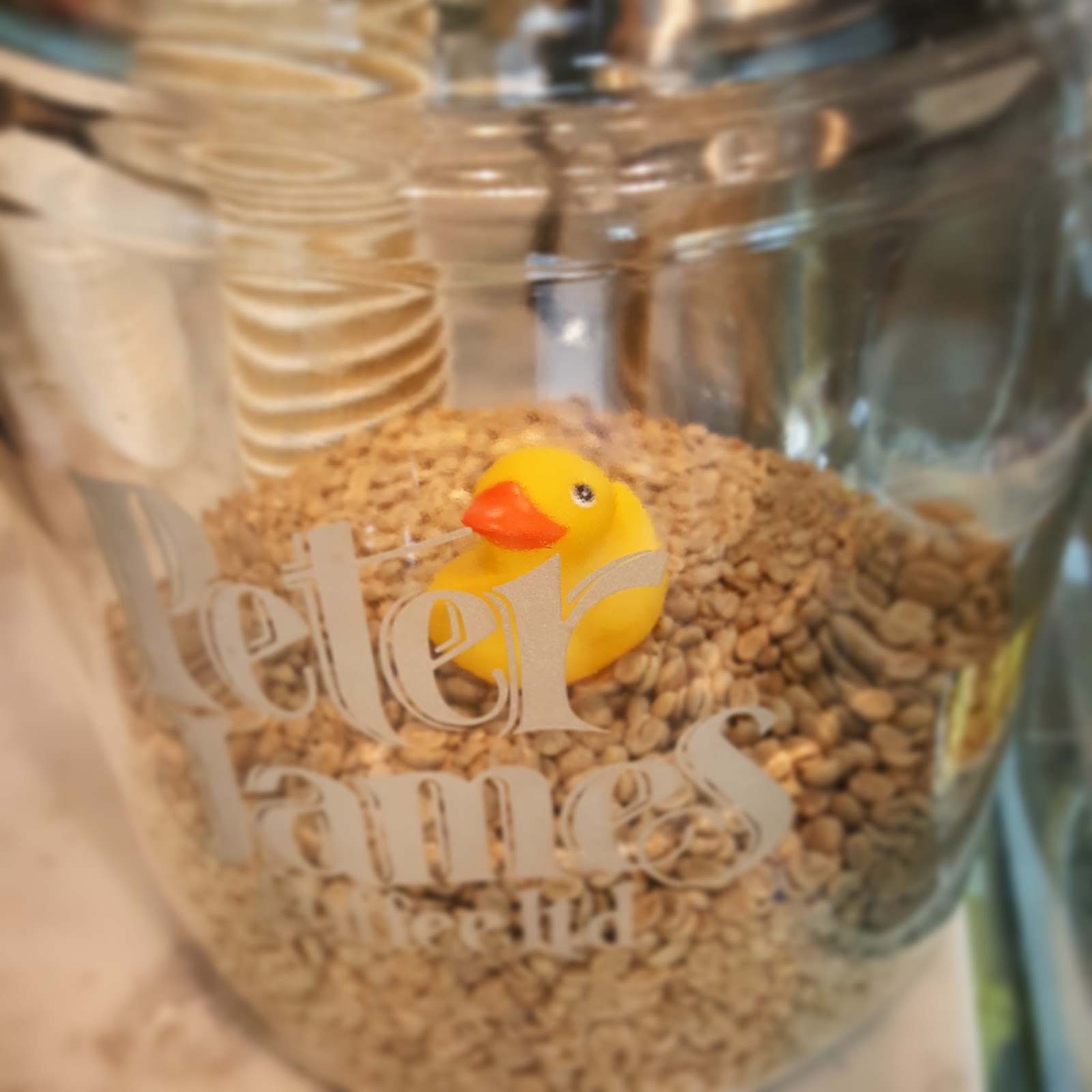
I've been here many times before and usually just have coffee. The Peter James they get from Fremont already ground and it's a single-origin from Costa Rica. Thumbs up for that. Their espresso bean is a secret.

FOOD PAIRING: Two rounds of coffee meant two rounds of pastries! The aroma was wonderful as soon as I walked in, just minutes after they opened. Most of the freshly baked pasteries were still cooling on the racks instead of steaming up the case. The scones came out just after I arrived. Very tempting but I thought the berry flavors might not work well with my coffee choices. So, for the cappuccino, I chose the kouign amann, which is buttery like a croissant but also sugary and crunchier. Both were light and airy, very easy on the palate. Big gulps, big bites and gone too quickly! For the espresso, I chose the mini éclair. About the size of Mendo, it seemed harmless. I thought the chocolate would match the strength of the espresso and I was right, but the abundance of the cream filling was the real kicker - fabulous pairing. I could stay there all day.

BIKE AMBIANCE: The shop is in a strip mall and they've done their best to make an outdoor seating area like you'd find in Paris, but that doesn't leave much room for more than perhaps two bikes. Otherwise, it's fine. The decorations were decidedly Francophile, but not TdF-ophile.

DUCK'S VIEW: It never ceases to amaze me how easily people accept a grown man carrying around a rubber duck and taking too many photos. Mendo was allowed to "swim" in a display jar of green coffee beans. The decor suited him well: much distressed white, chrome and black. You may noticed the orange "Field Notes" memo book in the background. I've started carrying it and using the "bullet journal" method for organizing and journaling - highly recommend both. The orange version is called the "Expedition Edition" and it's waterproof. Both the color and the water resistance go well with Mendo.

THE BIKE: Somasee Day 1 post.

THE RIDE: In keeping with the Coffeeneuring spirit, the ride was all about the coffee. Just a quick spin down Main Street past the farmer's market and straight to Sugarie. No frills, no detours. The weather was cloudy and cool but promised to be a rather nice, 50-60-degree fall day. Perfect for coffee. Straight home by a hillier route. Yes, it's more of a struggle on a single-speed but two rounds of coffee didn't hurt.

INSERT THEME HERE: Perhaps today's theme is brightness. My new Field Notes book, Mendo, my "Traffic Master" jersey, the sunny disposition of the Sugarie owners and the atmosphere of the shop. I titled the post with "Their Favorite Bike" because the owner usually mentions my bike.

Sunday, October 18, 2015

Mendo's Coffeeneuring Challenge 2015 - Day 4


Sunol Railroad Cafe and the Invisible Cyclist


I didn't intend on doing another Coffeeneuring run this morning, but I didn't feel like a big ride, either. So I tucked Mendo in my pocket just in case and his mere presence made it happen.

### Coffeeneuring Control Stop #4 ###


DATE: 10/18/15
DRINKS: Seattle's Best
MILEAGE: 15.6 miles
COFFEE SHOP: Sunol Railroad Cafe

Worm's-eye view from across Main Street. Almost perfectly timed - that's me entering the frame...

Another Timer Photo Experiment
BACKGROUND: Mark Martin owns and runs the little cafe on Main Street in Sunol, where he grew up. Situated a block from the Niles Canyon Railway station and a block from the Sunol Glen School, where my son attended - Sunol is really only about two blocks long - it occupies a house built after the 1906 earthquake. Sunol, population 913, is a pocket of small-town life with more than its share of eccentricities (residents unofficially elected a dog named Bosco as their mayor in 1981). 
"The place is a throwback, it's old-fashioned Americana," says Martin. It's more about comfort food than coffee, plenty of hellos and how-are-yas to old friends. The review I read referred to the diner's funky Mayberry-in-Silicon-Valley vibe. This was my first time inside, even though I'd been by it hundreds of times. So I figured I need a place like this in my Coffeeneuring group, to contrast the "rock star" baristas.
COFFEE REVIEW: I am too much of a novice to be a coffee snob yet, but I was a bit let down to see the "proudly serving Seattle's Best" sign in the window. But that wasn't really the point for this stop. I didn't ask if they were serving the "house blend" or one of the numbered series of "signature blends". It was fine. It really was.

FOOD PAIRING: The covered pastry platter was empty by the time I got there, so I had an English muffin. That was pretty good, too. They paired well enough. But this is really a better place to sit and have a meal.

BIKE AMBIANCE: The parking lot down the street for the Niles Canyon Railway is a common meet-up for cyclists, as is the school. And there are several great rides from here. On the weekend there are probably as many cyclists as cars rolling down the only street. But the cafe doesn't give off a cycling-friendly vibe, per se. It's a train-friendly vibe, for sure. But having said that, everyone is welcomed here and everyone feels comfortable - as you would be at gramma's house. Parking is adequate and the town itself is safe enough that there's no worrying.

DUCK'S VIEW: This is a great place to be a duck. Well, the town is - if a dog can become mayor - but the cafe is a railroad cafe. Not great for ducks, but great for old men wearing pinstriped overalls and an engineer's hat. Mendo was happy on the bike ride down here. He wanted to get out when we crossed Verona Bridged and hop in the arroyo. It flows slowly down to Sunol and he wanted to meet me there. Sorry, not happening.

THE BIKE: Volagi, see Day 1 post.

THE RIDE: Although it looked fine with possible sunrise photo opportunities, it actually rained. (That's a bit rare here.) I took the Happy Valley route, detoured into the Serenity neighborhood and noticed I was at the intersection of Sanctuary and Sleepy Head. So there, that's how the ride was. And that's why coffee was in order.

INVISIBLE: I enjoy cycling for many reasons. One is the serenity of being alone on a scenic country road. That's my happy place. For most of these CC2015 rides, I'm trying to venture into new places, chat up the owners and maybe learn something about coffee. I realize I'm wearing lycra in very loud colors, but I'm man enough to own it. But I was a little apprehensive entering the Sunol Railroad Cafe knowing it was a place for the locals - and I wasn't really one of them (although I thought I could fake it pretty well). But although the staff was nice, they were "Midwestern nice" - term I made up, being from the Midwest. It means that they don't gush with fake friendliness, they are just nice. They might end up being your friend for life, but not at first. And so I was politely left alone while they greeted others heartily - people they obviously knew much better. Eventually, I paid my bill, left $2 and left. I doubt they thought twice about me. I would certainly go back for a meal. But not just for coffee, unless I was wearing my overalls.