Thursday, October 1, 2015

Hydreco and My Dad

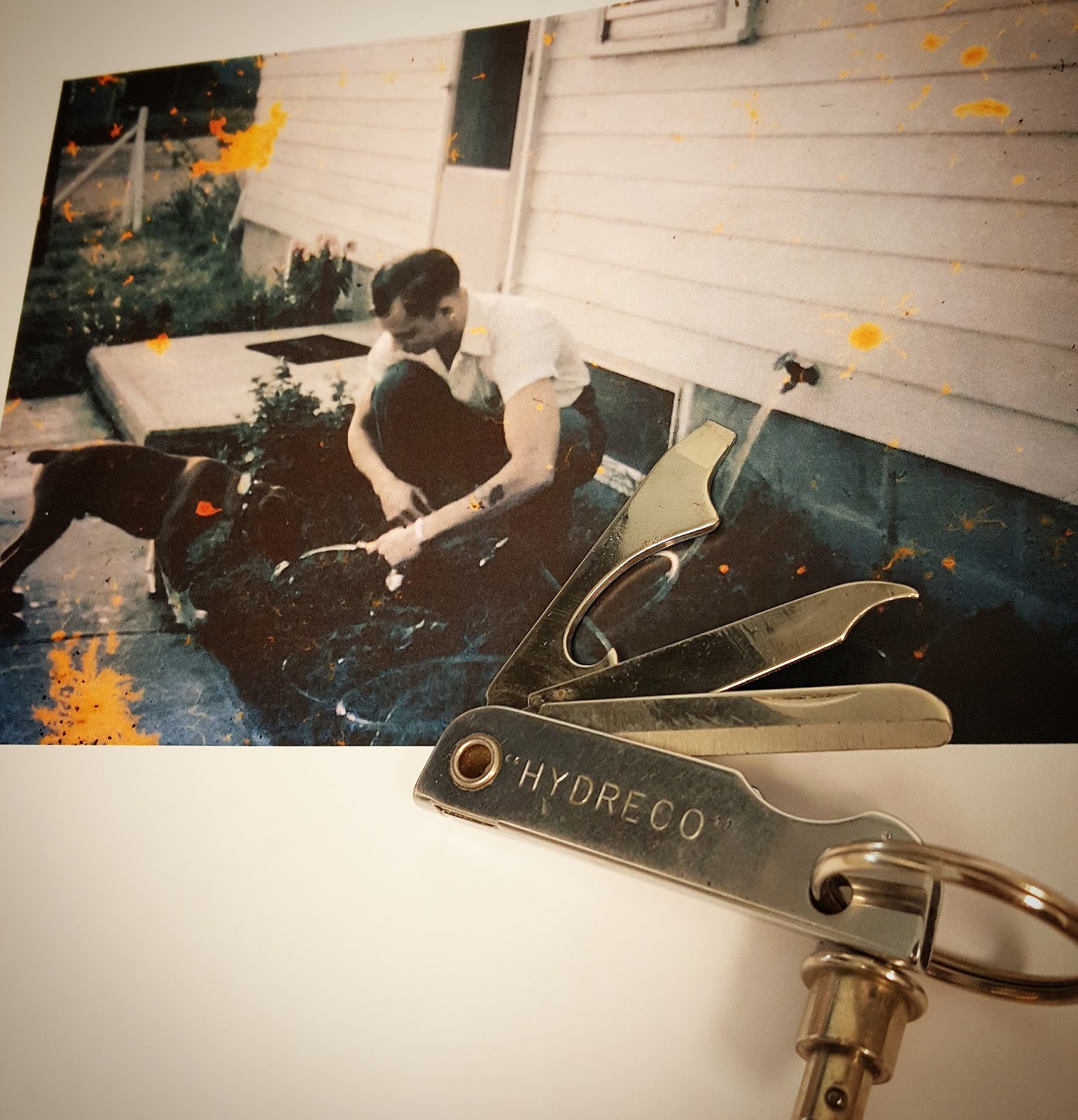
I have a combination nail file, bottle opener, knife with “HYDRECO” engraved on it – quotes included. I keep stuff like this. It’s on a ring with a detachable keyring that is long since gone. Hydreco is the company where my dad worked for many years while I was growing up. They made big, heavy hydraulic pumps and valves for industrial use and my dad was a machinist.

Near as I can tell, Hydreco goes back to the 1930s as the Hydraulic Equipment Company. There have been so many mergers and acquisitions that the lineage is rather foggy. There is some association with Hamworthy Engineering, David Brown Group, Allied Signal and Clyde Blowers throughout the years. How they came to my hometown is difficult to find. It’s only slightly clearer how my family came to my hometown.

Before Hydreco, I have a vague recollection of my dad working at Eckrich (Armour-Eckrich Meats, founded in Fort Wayne, IN), more of a fond olfactory memory of smoky links. We lived in Portage at the time, a new suburb of Kalamazoo, MI. We had a brand new house on Capri Street. Down the street was a guy named Al Yingling and apparently his wife watched my brother and me while my mom was at work at Upjohn’s (The Upjohn Company, fascinating history). Al got my dad the job at Hydreco. At Eckrich, dad had a friend named Joe Gizmundo. I remember Joe as an architect with a really cool house built into a hillside. My parents wanted more land; they were not cut out for suburbia. Joe found the farmland property that became the home I grew up in, which happened to be less than a mile from Hydreco.

Dad’s 1967 Chevrolet Truck

Dad drove an old 1967 half-ton Chevy pickup to work. It had a straight six, three-on-the-tree, highway mirrors and a full-length, fleetside bed. A V-8, shortbed C/10 would be classic today, but not this one. I don’t think he bought it new – that seems like the last thing he would ever do (especially a truck). But he must have purchased it fairly new with low miles. He only drove it to work and back, hunting, hauling, etc. I don’t recall ever seeing him wash it. He would change the oil about once a year on principle – not based on mileage. That was the only time it was ever in the garage.

Visiting Dad at Work

There were several times that I went inside Hydreco to visit. It was a magical, mysterious experience for a bashful, clean-cut kid. It took a minute for your eyes to adjust to the darkness. It was cavernous with impossibly high ceilings with huge buckets of dank yellow light hanging from conduit amid the overhead conveyors. The smell hit you right away and then you could see the green cloud through the whole place. The smell and the fog came from the pea-green lubricant that sprayed as the mills and drills created the pumps and valves from raw castings. The lubricant served to carry away the metal shavings and keep the cutting tips cool. It’s an unmistakable smell and conjures up this very image still today. Much like high-octane exhaust fumes, it’s nauseating but a happy memory.

The floor was concrete but dirty with metal filings and rubber left from the fork lift wheels. Danger was everywhere. Clearly this was no place for kids. Men would stare and sometimes taunt. Then they would recognize my dad and say something only mildly reassuring. The constant hum of the machines would muffle the voices and even the warning buzzers that went off randomly. The explicit posters by toolboxes reminded me that this was a place for men. No smocks, no hard hats, just metal grating to protect you from flying debris. Of course, nothing about this scene could exist today.

My dad would be assigned to one machine or another, working on this pump or that. The pea-green Goliath of a machine seemed 10-feet tall, had conveyors going in and out, and must have weighed many tons. The partially tooled pumps would queue up on one side and finished ones were crated on a pallet on the other side awaiting a fork lift. Dad’s job was to interpret the drawing, set up the machine, calibrate everything to within thousandths of an inch and work out the simplistic automation (mostly lights and buttons, no fancy robotics in those days). There was some standard rate assumed and I seem to recall that dad frequently hit 300% of quota. And I recall dad having massive forearms and bit meaty hands. Steel-toed boots, jeans and a white T-shirt – no uniform.

Perception of Engineers

The uniform, if you call it that, belonged to the engineers. They wore the short-sleeved, white shirt with the thin black tie and pocket-protector. They sat in the offices at the front of the building and entered through the double-doors up front by the flagpole. The workers entered from the side, near the loading dock. I really have no idea what the engineers did at Hydreco, but they formed my first impression of engineering. With the benefit of decades of hindsight, I presume they designed the pumps and managed the transition from design to actual manufacturing as well as specifying the manufacturing equipment.
To the machinists, the engineers were a bit of a joke. They may have been educated, but they didn’t “know” things. The machinists would explain things to the engineers when they ventured out from the air-conditioned cleanliness of their offices with their pea-green metal desks and vendor-logo ash trays. Some machinists knew the necessary equations and other just simply had the feel, but they could have designed these pumps themselves. They lived with the pumps for eight hours a day, fixed the machines, perfected the manufacturing flow and put up with the condescending tone from the detached engineers.

Moving to Georgia for Cheaper Labor

Sometime in the late 1970s, the higher-ups at Hydreco decided to move the facility to somewhere in Georgia – presumably for cheaper labor. At least that’s how it filtered down to me. My dad’s factory was a union shop and I’m sure the one in Georgia had to be, also. But it must have made financial sense. It’s just business. Long before jobs were sent off-shore for cheaper labor in other countries, there was a migration to other parts of the United States for the same reason. Leaving the same void in the community and resentment toward that other place. However, Hydreco was not a huge part of the economy for my hometown and the disruption wasn’t that significant. Not even in our own house. My mom always worked. Dad did what he could until he landed another job. That’s another story.

Craftsmanship and Building Everything from Raw Material

Hydreco built hydraulic pumps and valves. Somewhere else, raw iron was cast and these casting were shipped to our factory for machining and assembly. In that sense, it was not quite raw materials in and finished goods out but close. And dad brought that sensibility home with him. He didn’t buy what he could make and he didn’t pay someone else to do something that he could do. He had more time than money. We had piles of angle iron, pipes, bar stock, gears and random chunks of steel out back. Dad had a band saw, arc welder, acetylene torch, drill press, a lathe and enough tools to fill a professional garage. We had two garages. Come to think of it, we built that second garage ourselves. That’s yet another story.

And Craftsman wasn’t just the name on the toolbox. Even with the benefit of decades of hindsight, my dad was really good with tools and took great pride in his work. It seemed like he could do anything. He tried to teach me, but I could never be as good as him. Today, I appreciate a good bead from a good welder. I look at the joints in exposed woodwork. Drips in paint. Cover-ups. My dad is my benchmark for good craftsmanship. Made in U.S.A.
He may have learned that at Hydreco. Maybe there was some informal apprenticeship that occurred with some older craftsman there. Maybe it was in the Navy. Maybe it was his dad. He never really said. It was just the way things should be done. It mattered.

I use the nail file, bottle opener, knife combo tool occasionally. It’s a physical reminder of Hydreco. And it’s a gateway to all those other memories. The smell of that coolant. The belief that I could build anything or fix anything if I had to (fortunately, I don’t). The sense of a craft and of craftsmanship. Hydreco taught me a little about the relationship between the workers and the thinkers; and the need for humility in my own career.

I probably wouldn’t forget all this if I didn’t keep this stuff. But I keep stuff like this.

NOTES:

https://www.hydreco.com/about-us/our-history (Poole, England website)

http://en.hydreco.fi/our-history (Finland website)

Monday, September 14, 2015

Bicycles, Quadricycles the Early Men of the Motor City

I grew up in Michigan and was thoroughly immersed in the automotive industry and its history. Not cycling; that came later. The hallowed ground of Speedway, IN, - the brickyard, the Indy 500 – was a few hours’ drive to the south. Any history that really mattered was housed a few hours’ drive to the east in Dearborn, MI – The Henry Ford Museum and Greenfield Village. I knew that both AC Spark Plug (aka ACDelco, a division of General Motors) and Champion Spark Plug were started by Albert Champion. I knew that from the four founders of the Indianapolis Motor Speedway (Fisher, Wheeler, Allison and Newby), that Fisher started Fisher Body and Allison started Allison Transmission (also both divisions of General Motors) and made helicopter engines. I knew that Barney Oldfield drove Henry Ford’s No. 999 and basically helped Henry start his Ford Motor Company. I knew that Louis Chevrolet was Swiss – not French, the Dodge Brothers worked for Ransom E. Olds (your father’s Oldsmobile) and Ford, and that the Duryea brothers built cars before any of them – but they weren’t from Detroit (the Motor City), so you’ve probably never heard of those two. Yes, I knew a bit of history.

So let me tell you “the rest of the story” as Paul Harvey used to say.

Albert Champion


Born near the Arc de Triomphe in Paris in 1878, Champion was actually a bicycle courier as a kid and became a professional cyclist at 18 years old – specializing in track racing (velodromes) and motopacing (speed records while drafting). He was only 5’7”, which was ideal for paced racing behind tandems, triplets, and ultimately motorcycles. Parisian journalist Victor Breyer nicknamed him “petit prodige” (little marvel). He was a very successful cyclist in those types of events but had never raced in the types of road races we commonly see today like the Tour de France. Paris–Roubaix is a famous one-day road race that is even older, having started in 1896. Called “the Hell of the North”, Paris–Roubaix is known for its cobblestone sectors, and is very hard on cyclists. In 1899, trying to expand its popularity, the organizers allowed motorcycles for pacing (barely faster than bicycles in those days). Thus many track specialists entered the race; what advantage they may have had from experience in paced races, they lost in inexperience on the cobbles and other bad road surfaces. Champion, now 21, was an outsider but the others chased when he broke away soon after the start. Only one competitor could come close to catching him, getting to within a minute at half distance. Champion slowed through hunger near the end, riding the worst of the cobbles at walking speed, but at the velodrome in Roubaix he still had a lead of 23 minutes. Champion finished in 8:22:53, the champion of Paris–Roubaix.

His win came as a surprise to many and increased his popularity. Champion went to America after his win to profit from track racing contracts. Around then, Champion had opened a factory to make spark plugs. After retiring from cycling, he went on to pursue his interests in automobile racing and in business. "He had contracted the car virus", said the historian Pascal Sergent.

Carl Fisher

I knew of Carl Fisher from a famous photo of the four founders of the Indianapolis Motor Speedway along with Henry Ford. Until the mid 1980s, most GM cars had “Body by Fisher” on the door sill – that’s also Carl Fisher. I didn’t know that Carl Fisher was crazy, though. Well, maybe not crazy, but a highly energetic huckster like P. T. Barnum. Fisher became wealthy as a result of his partnership with James Allison in the Prest-o-lite company, making headlights for early automobiles. Fisher creatively promoted a plan for a highway spanning the country from New York City to California. He estimated the highway would cost $10 million to build and sought pledges from the automobile executives and – except for the notoriously cheap Henry Ford – managed to get the project funded. This became the Lincoln Highway with Fisher as vice president.

As the Lincoln Highway progressed, Fisher had an idea for a winter get-away for his automotive buddies. He started a massive project improving a jungle of swampland in Florida that came to be known as Miami Beach. Amazing. And how would Midwesterners get there? Fisher, the “father of the Lincoln Highway,” used his promotional talents to create another highway: the Dixie Highway. Quite impressive: Prest-o-lite, Fisher Body, the Indianapolis Motor Speedway, the Lincoln Highway, the Dixie Highway and Miami Beach. And, of course, you know what else? He was a cyclist!

Fisher quit school when he was 12. By 17, he and his two brothers opened a bicycle shop in Indianapolis where they repaired flat tires for just 25 cents. Fisher managed to be in the right place at the right time as the bicycle craze swept the country. He would ride in the Indianapolis Zig-Zag Cycling Club’s rides to distant cities. Joining Fisher on those rides were James Allison and Arthur Newby, future founders along with Frank Wheeler of the Indianapolis Motor Speedway.

Local journalist and poet William Herschel of the Indianapolis News noted that Fisher was nicknamed “Crip” (short for cripple) by his bicycling buddies “because he frequently, in bursts of speed, took a spill and ended with many bruises and cuts.” Although handicapped by poor eyesight, Fisher managed to compete in bicycle races, battling with the likes of champion racer Barney Oldfield. Fisher convinced George Erland, a leading Ohio bicycle manufacturer, to supply him with $50,000 worth of merchandise on credit. Ever the huckster and short on cash, Fisher performed stunts to promote his store. Wearing a padded suit, he rode a bicycle across a tightrope stretched over Washington Street; he built and rode a 20-foot-high bicycle; and he released a thousand toy balloons, 100 of which contained tickets for a free bicycle. His wife said that he “owned the finest bicycle shop in all of Indiana” at the age of 19. By the turn of the century, he became enamored with the newly invented automobile. Fisher told Oldfield, “I don’t see why the automobile can’t be made to do everything the bicycle has done.”

Albert Newby

You already know that one of Fisher’s partners in the Indianapolis Motor Speedway was Albert Newby. I’ll bet you didn’t know that the Zig Zag Cycling Club of Indianapolis was co-founded by Newby. He was ahead of the game in cycling. Newby was working as head bookkeeper at Nordyke and Marmon in Indianapolis (later the Marmon Motor Company and, yes, the makers of the “Marmon Wasp” which was driven to victory in the first Indianapolis 500 by Ray Harroun) when he decided to turn his love of cycling into a business.
Together with Glenn G. Howe and Edward C. Fletcher, they formed the Indianapolis Chain & Stamping Co. which manufactured Diamond bicycle chains. At this time, all the bike chains were being made in Europe, but Newby’s chains quickly gained over 60% of the American bicycle chain market. By the way, Orville and Wilbur Wright were Diamond chain distributors when they were bicycle mechanics in Dayton. The first airplane used a Diamond chain.

Newby wasn’t the huckster that Carl Fisher was, but he convinced the League of American Wheelmen to hold their National Meet in Indianapolis – comparable to the NCAA Final Four or the Super Bowl today. What he needed, of course, was a track! To that end, he built the Newby Oval in 1898 — one of the fastest bicycle tracks in the country at a cost of $23,000. The track had electric lighting and seats enough for 20,000 spectators. It was a quarter-mile white-pine board velodrome (four laps to the mile, in the lingo of the day). The track lured some of the best racers in the country like "Plugger Bill” Martin, Tom Cooper and a 15-year-old named Marshall "Major" Taylor. Have you heard of him?


One source credits Newby with creating the hugely popular six-day bicycle races that still boggle my mind. But according to Peter Nye, the six-day races were not Newby’s idea. Perhaps he brought them to Indianapolis, though. In America, it was with the Madison Square Garden six-day races that created the boom. And it was Tom Eck who promoted the first Garden Six, in 1891. But Newby did eventually become president of the National Motor Vehicle Company in Indianapolis – not Detroit – so I’ve never heard of it.

Henry Ford

Henry Ford needs no introduction, but he was not the first to make a car and cruise the streets of Detroit. Just as thousands still cruise Woodward Avenue to this day, at just after 11pm on March 6th, 1896 the very first automobile rumbled past crowds of onlookers. This car was driven by its builder, 28-year-old mechanical engineer Charles Brady King. He was followed by a tall, slim man on a bicycle: Henry Ford. Three months after riding behind King, Ford went for a cruise in his first automobile. Ford’s Quadricycle featured many bicycle parts: a tubular steel chassis, 28-inch bicycle wheels and pneumatic tires. There is so much written about Ford after this point, some quite troubling, but little about his love of bicycles.

Ford sold his car to his friend Charles G. Annesley for $200. (Trivia: Annesley sold the Quadricycle to A. W. Hall, a bicycle shop owner.) Annesley, like Ford, was a cyclist. Ford worked for Thomas Edison’s company as a mechanic; he was neither a bicycle mechanic nor a racer but he always rode bicycles. Ford rode to work at one of Detroit’s Edison electric plants on his bicycle. Ford also cycled to work when he was developing the Model N, precursor to the Model T of 1908. He may be known now as the father of the US auto industry but he was careful with his money and knew that his trusty bicycle could get through Detroit quicker than the town’s trams. Throughout his life, Ford remained a cyclist. Time Magazine, in August 1940, reported that on his birthday, the 77-year-old automotive billionaire “took a ride …on the light (12-lb.) English bicycle on which he likes to take a three-mile spin every evening after supper."

Barney Oldfield

Henry Ford built cars for the masses, but before that he also built a few race cars. One of the more brutally powerful cars was the famous Number 999, named after a record setting New York Central train. Purportedly, the engine had cylinders the size of gun powder kegs and developed close to 100 horsepower – about eight times that of a conventional car. “The roar of those cylinders alone was enough to half kill a man!” Ford once said. Ford had driven his 999 for himself in a race or two, but soon decided that he felt safer just making the cars. The racing scared the life out of Ford who compared it to going over Niagara Falls in a barrel. He declined to pilot it in the Manufacturers Challenge Cup. He needed someone else with sheer grit and daring to drive his car and 24 year old Barney Oldfield was the man for the job. After seeing the 999 for the first time, Oldfield told Ford, "But I've never driven a car." Inexperienced as he was, Oldfield is rumored to have learned the controls of the car the morning of his first race, and by the end of the day he had defeated what was thought to be the world's fastest car, the Winton bullet. This launched both of their careers.

Soon Barney Oldfield was a household name and was racing cars all over the country, setting speed records left and right. Oldfield was the first ever to drive around a mile track in less than a minute (1903). This was four years after “Mile-a-Minute” Murphy accomplished the same speed on a bicycle – drafting behind a locomotive on a specially boarded section of railway – by the way. But I digress; let’s get back to Barney.

His early life was very hard. He quit school at 12 and began work as a water boy on a construction crew, and moonlighted as a bellhop. He was fascinated with speed and taken up by the bicycle craze. The lightweight bicycles used by racers were still too expensive for him. However, he soon discovered that a tenant of the Monticello Hotel had a lightweight bicycle, and stored it in the hotel basement. Each night, Oldfield "borrowed" it from its unsuspecting owner, and sped through the dark streets of Toledo. According to William Nolan in the Toledo Blade, Oldfield told his parents, "Someday I'll own the fastest cycle in the whole wide world. People will come from a thousand miles away just to watch me ride it!" At age 16, in 1894, he entered his first bicycle race and won; his prize was a $25 diamond ring, which he pawned to finance his next race. Soon, the Dauntless bicycle factory asked him to ride for them in the Ohio state championship. Although Oldfield came in second in the race, he secured a job and was soon being paid handsomely by the Stearns bicycle factory in Syracuse, New York to race on its amateur team. When he won his next race, he sold his gold medal back to the promoter for cash. Oldfield was a large, strong professional bicycle racer. After an unsuccessful venture in coal mining in Colorado, he resumed his bicycle racing career in Salt Lake City, UT. He became associated with fellow racer Tom Cooper who was Henry Ford’s partner in the Number 999 (and had also declined to drive it!). So Tom suggested to Henry that Barney could drive it. And now you know the rest of that story, too.

Louis Chevrolet

Baseball, hot dogs, apple pie and Chevrolet. Do you remember that song? How about the red, white and blue USA-1 license plates that symbolized Chevy in the 1970s (before the gas crisis)? Chevrolet epitomized America, sounded French but was the name of a Swiss car guy. I assume you are way ahead of me and expect to hear about his love of bicycles. How smart you are!

As you do when you are Swiss, Louis' father Joseph worked in the watch industry, but Louis learned to repair and later race bicycles. He would eventually build and sell his own bicycle called the Frontenac. Louis not only raced, but he won numerous races on Darracq bicycles. He was a husky teenager and became a champion bicycle racer after he tailored bicycle gear ratios to take advantage of his strength. At some point he was given a job at the Mors and Darracq Company. Darracq built the well known Gladiator bicycles, however Louis was intoxicated by the Darracq internal combustion engine. This diversion would end his cycling career, prompt him to move to Montreal and ultimately Detroit. Bye, bye miss American pie.

Horace and John Dodge

Thanks to the recent Dodge television commercials, you probably think you know the Dodge brothers.

Horace Elgin Dodge and John Francis Dodge were young cyclists and in 1897, with Canadian Fred Evans, founded the Evans and Dodge bicycle business. Their bicycles were based on a dirt-resistant ball-bearing assembly the brothers had patented the year before. “Mr. Dodge” was a stoker in a two-mile tandem race on the Detroit banked track in 1897 and the brothers were active members of the Detroit Wheelmen, volunteering to be race judges and timers. (Forgive my name-dropping, but Horace also worked part-time for Henry M. Leland making high-precision parts for the bicycle industry. Leland started the Cadillac Motor Car Company in 1903.) The Dodge brothers dissolved the partnership with Fred Evans in 1900 and used their share of the proceeds to establish their own machine shop in Detroit, making parts for the fledgling automobile industry. Contracts to supply to Ransom Olds, maker of the Oldsmobile, and the Ford Motor Company made the brothers’ firm into one America’s biggest auto-parts suppliers. From 1903 until 1914, the Dodge brothers supplied about 60 percent of the total value of the cars that Ford built. After that, they branched out on their own, becoming the competitive pair portrayed on those television commercials.

Well into the period when they were making fortunes from the automobile business the Dodge brothers were still active in cycling. In 1905, John Dodge ran for a position on the Detroit Wheelmen board and Horace was elected the club’s second vice-president the following year. Ford might have been Detroit’s most famous cyclist but the Dodge brothers were better.

Charles and Frank Duryea

After graduating from high school in 1882, Charles Duryea became a mechanic and entered the flourishing business of bicycle repairs, one of the greatest 'growth sectors' of the 1880s and 1890s. He built a high wheel bicycle in his teens. His brother, Frank Duryea, was several years younger, but did much the same. They moved often and in different directions. Both worked in Washington D.C. in a bicycle shop briefly before splitting up again. At one time Peoria, IL, was one of the largest manufacturing centers for bicycles in the United States. Charles moved to Peoria and started a business with Geo W. Rouse to produce a brand of ladies bicycles called the Sylph. Rouse, Hazard & Co manufactured 7,500 bicycles in 1896. The Peoria Rubber and Manufacturing Company manufactured 10,000 bicycles and 25,000 pairs of bicycle tires annually; they sold out to the American Bicycle Company. The Patee Bicycle Company made over 5,000 bicycles annually. The Ide Mfg. Company made 2,000 bicycles annually as did Luthy & Co. But this isn’t about Peoria; it’s about the Duryea brothers. Later, Charles was contracted to build bicycles for a firm in Rockaway, NJ, along with his brother Frank. Ultimately in 1893, they moved to Springfield, MA, and got distracted by internal combustion engines and started the first automobile company in America. It featured parts from a Columbia tricycle bought from the Pope Manufacturing Company. One of their automobiles was bought by Henry Wells of New York. On May 30th, 1896 Wells drove his Duryea Motor Wagon into New York City to take part in a horseless-carriage race organized by Cosmopolitan magazine. While racing, on public roads, he crashed into Evelyn Thomas, riding a Columbia bicycle on Broadway near West 74th Street. Wells became the first motorist arrested for what would later become known as “dangerous driving". Apparently, they also built the first car to sputter along Washington’s Pennsylvania Avenue. It was somewhat of a circus freak, literally (and appropriately), leading out a parade by Barnum & Bailey’s Greatest Show on Earth in 1896. The car was upstaged by eight baby elephants and a gorilla called Joanna.

Early Sylph bicycle
The Duryea brothers may have been immortalized for their automobile, but Charles remained a cyclist. He was a member of the League of American Wheelmen. He wrote in the club magazine, “From the dawn of history to the present, civilization and roadways have been linked together. Whether landways or waterways, whether traversed by ships or slaves, canal-boats or camels, canoes or cyclers, the progress of any country has been reflected by its system of roads.”


And with that comment, I suggest you read “Roads Were Not Built For Cars” by Carlton Reid.

And Now You Know

The rest of the story doesn’t stop there. The connection between cycling speed freaks and bike mechanics who became pioneers in the automotive industry goes way beyond Detroit. In fact, this whole theme is even stronger in Europe. Cycling carried on in Europe and maintained the people’s interest, unlike America where cycling almost died as cars took over. Cycling became so unimportant that history failed to mention these connections. Today, bicycles and cars seem to be polar opposites; they seem antagonistic toward each other. Yet they are so closely related, different branches of the same tree. Riders on the same road.


NOTES

http://www.theautopartsshop.com/carchronology/early-days-of-duryea-brothers.html
http://genealogytrails.com/ill/peoria/biz/EarlyManufacturers.htm
http://www.thewheelmen.org/forum/topic.asp?TOPIC_ID=7549
“Albert Champion: The little marvel” By Peter Joffre Nye, Published Aug. 15, 2015
http://velonews.competitor.com/2015/08/news/road/albert-champion-the-little-marvel_381413
“The Hoosier Barnum: Carl G. Fisher”, by IHS staff
http://www.indianahistory.org/our-collections/reference/notable-hoosiers/carl-fisher#.VfCslqRVhBc
http://archive.indystar.com/article/99999999/NEWS06/80508055/Carl-Fisher-James-Allison-founding-Indianapolis-500
The Father of the Indianapolis Motor Speedway (http://www.sportscardigest.com/history-of-the-indianapolis-500-part-1/ )“When bicycle racing made Indy famous”, by Dawn Mitchell, dawn.mitchell@indystar.com, 4 July 24, 2015
http://untoldindy.com/2012-05-22_Bikes.html
https://history.gmheritagecenter.com/wiki/index.php/History_of_Louis_Chevrolet
http://www.indystar.com/story/news/history/retroindy/2015/07/24/bicycle-racing-made-indy-famous/30623979/
http://xroads.virginia.edu/~CLASS/am485_98/sarratt/barney.html
http://www.oldfieldsliquorroom.com/history/
http://www.lakesidehistory.org/Racetrack/racetrack.htm
http://www.m-bike.org/blog/2010/04/02/bike-racers-helped-create-ford-motor-company/
http://www.encyclopedia.com/doc/1G2-3407900413.html
Wikipedia
Sunday, August 30, 2015

Women of Destiny

What was it about history class that sucked the life out of the life stories of amazing people? Reduced to dates and battles and policies, I cannot remember a history class that I ever enjoyed – I can barely remember them at all. The Louisiana Purchase, the American Revolution, Lewis and Clark – oh, spare me the agony! But as I read for my own enjoyment, I find that there are real stories behind the dates; real people behind the battles; and the policies are not all dribble from old pompous white men with starched collars.


New Orleans

Wikipedia: La Nouvelle-Orléans (New Orleans) was founded May 7, 1718, by the French Mississippi Company, under the direction of Jean-Baptiste Le Moyne de Bienville, on land inhabited by the Chitimacha. It was named for the Duke of Orléans of France. His title came from the French city of Orléans.
All of the history books that I read in school were written by white men of European descent, like me. Like New Orleans, the founding of anyplace in America could have the postscript “on land inhabited by…” Until this day, I had no awareness of the Chitimacha. Through the magic of the internet, I now know that they were a matrilineal society – meaning that everything passed through maternal lines, everything from property to the actual acceptance of being Chitimacha (if your mother was Chitimacha, so were you …if your mother was not, you were not). Prior to the 1700s, European diseases decimated the population from perhaps 20,000 to several hundred. Between 1706 and 1718, nearly all of them were killed in a bitter war with the French, which lends a different tone to the founding of New Orleans “on land inhabited by the Chitimacha.” An interesting side note on the matriarchal aspect of the Chitimacha – as the last of their land was about to disappear to white ownership, the Chitimacha women sent out a plea that was answered by another woman, Sarah Avery McIlhenney. McIlhenney (of the Tobasco family) purchased 260 acres of their traditional land, helped petition the Bureau of Indian Affairs for federal recognition and ceded the land to them. But this is not basis for my “Women of Destiny” story.

Ignored by history books, amid New Orleans’ back and forth between French and Spanish rule is the family of Frenchman Nicolas Bourgeois and his Spanish wife, Marie Joseph Tarare. In 1733, they had a daughter named Marie-ThĂ©rèse and this is where our story begins. Shortly before she turned six, her father died. The following year, Marie-ThĂ©rèse’s mother married Nicholas Pierre Carco. History has obscured the reasons, but young Marie-ThĂ©rèse was sent away to the Ursuline Convent and then ushered into an arranged marriage at the age of 15. Today, that would generate at least some discussion but apparently not in 1748. Her new husband, RenĂ© Chouteau, had recently arrived from France, was 10 years older and has alternately been described as an innkeeper, liquor dealer, and pastry chef. Let that image sit for a minute. They promptly had a child, RenĂ© Auguste Chouteau, Jr. who we shall refer to as Auguste Chouteau.

RenĂ© Chouteau purportedly abused Marie-ThĂ©rèse, then disserted her as he retreated to France, resulting in her return to the convent along with her son. The scandals continue. Marie-ThĂ©rèse remained Madame Chouteau, though she called herself Widow Chouteau. She did this not as a premonition, but because a widow had more legal rights than a married woman. As a widow, she could own property and have custody of her children. Madame Chouteau began living with Pierre de Laclède Liguest (we’ll call him Laclede) around 1755, so she was now 23 years old. She could not divorce or remarry due to the strict Roman Catholic doctrine, and society in New Orleans looked at them as sinners. In spite of this, the couple lived together as though they were married and bore four children together. Since Madame Chouteau could not divorce, all of the children had her last name rather than Laclede’s. I’ll choose to take this as a pseudo-matriarchal act of fate, or destiny.

Although too risquĂ© for any history classroom, this story was not without precedence by any means. The wife of Ben Franklin, Deborah Read, was deserted by her first husband and therefore could only have a common law marriage with Ben. And like Martha Washington, Abigail Adams, other wives of founding fathers and wives of so many pioneers and explorers, these women managed the businesses of their husbands while they were apart from them – making history. And in the case of the Franklin marriage, they were apart for 18 of their 44 years. The power and intelligence of these women is not well documented in traditional history books but is nonetheless self-evident, in my opinion.


Saint Louis

Wikipedia: St. Louis was founded in 1764 by Pierre Laclède and Auguste Chouteau and named after Louis IX of France. Claimed first by the French, the region in which the city stands was ceded to Spain following France's defeat in the Seven Years' War. The territory east of the Mississippi was ceded to Great Britain, the victor. The area of present-day Missouri was part of Spanish Louisiana from 1762 until 1803.
The area was “discovered” by Jolliet and Marquette in 1673 and later claimed for France by La Salle, as I was probably taught (I may have slept through that class). Of course it was well known for centuries by several native groups. A great metropolis, Cahokia, had once existed across the river. More than simply a confluence of great river systems, this area facilitated commerce as the primary crossroads of native peoples. Groups from the upper Mississippi, the Great Lakes, the Missouri, the Wabash, and Illinois rivers all frequented the area. A network of small-scale traders, French and MĂ©tis (Canadian, First Nations), already blanketed the region. The most significant were the powerful Osages living to the west of the new city and they would play a key role in the growing fur trade. Nonetheless, I don’t recall the phrase, “on land inhabited by…” but they buried their ancestors in great mounds on this land. Mounds that were mostly destroyed during the city’s development, but let’s get back to the story. Barely 10 years old, young Auguste would join Laclede’s business ventures in the fur trade up the Mississippi and Missouri Rivers. As the story goes, in 1763 Laclede obtained the necessary license from the French territorial government to trade with the Native Americans living near the Missouri River. Chouteau, Laclede and some 30 other men traveled upriver from New Orleans to establish a trading post. According to his own journal, in the winter of 1764, Auguste directed the men to start clearing the area. Thus he and Laclede are given credit for founding the city of St. Louis.

When Laclede and her son left on their founding journey, Madame Chouteau was pregnant with a daughter, Victoire. Sometime soon after the baby's baptism, she left New Orleans to make the seven-hundred-mile journey upriver with her three young children and infant in tow. She reached St. Louis in September 1764. Arriving at Fort de Chartres, Madame Chouteau and the children then traveled to Cahokia in a bumpy, two-wheeled charrette and crossed the river in a pirogue. The family began their new life in the newly built stone headquarters of the trading post. Four years later, they moved to a new house down the street. She was the first white woman to live on the west bank of the Mississippi River. Laclede deeded this residence to Madame Chouteau, along with the lot, an additional piece of land in the common fields, three black slaves, and two Indian slaves, Manon and ThĂ©rèse, both in their teens. Remember that they were not legally married, so these were gifts Pierre gave to her. It’s noted that he did this in consideration of his clerk Auguste's "faithful service" and "the affection" he bore the other four children of "dame Marie ThĂ©rèse Bourgeois and of Sieur RenĂ© Choutaud." Along with his step-children, she had three other children with Pierre. Despite the children to raise, she had an impressive amount of responsibility and independence. She ran a busy household, acquired property, owned cattle, kept bees, and conducted business transactions.

Surprisingly, or perhaps not given her increasing wealth and power, René Chouteau returned from France. He spent some time in jail in New Orleans in 1771 for slandering a rival baker. In 1774, he tried to make Madame Chouteau join him in New Orleans. She refused to leave St. Louis. René tried to bring legal actions against her because he wanted to claim her property as his own. Still Madame Chouteau would not leave St. Louis. René died in 1776, finally freeing her of the unwanted marriage. Imagine discussing this in history class.

Madame Chouteau did not, however, choose to marry Laclede. By this time, Laclede had fallen into debt. And she was a clever businesswoman. Though she loved him, she may have feared that she would lose her property and money to pay off his debts when he died, which happened fairly soon in 1778. Thereafter she fulfilled her destiny. After Laclede’s death, Madame Chouteau continued to manage the dynasty from their stone house. She was known to the community as the Mother of St. Louis. Her sons, Auguste and Pierre Jr., came to control the fur trade and were leaders in St. Louis business and politics for decades.

In this first generation, the growing Chouteau clan followed the time-honored patterns of mercantile families. Sons married daughters of established and mutually-beneficial families. Early transfers of property, large dowries, and a system of partible inheritance favored the entry of sons and sons-in-law into the parents’ businesses. In this remote frontier, women played a critical role in preparing their children for the complex world of international trade. It was Madame Chouteau who gave the family its sense of direction and purpose. She set the tone for the women that would follow.

Marie Thérèse Bourgeois Chouteau died at the age of 81 on August 14, 1814, leaving close to one hundred children, grandchildren, and great-grandchildren. [See sidebar on some of her interesting descendents.] A new generation of Chouteau women would create homes that served as gathering places and centers of socialization and education.


Lewis and Clark

Wikipedia: Napoleon sold Louisiana (New France) to the United States in the Louisiana Purchase in 1803.
Wikipedia: The Lewis and Clark Expedition was commissioned by President Thomas Jefferson shortly after the Louisiana Purchase in 1803, under the command of Captain Meriwether Lewis and his close friend Second Lieutenant William Clark. The primary objective was to explore and map the newly acquired territory, find a practical route across the Western half of the continent, and establish an American presence in this territory before Britain and other European powers tried to claim it. The campaign's secondary objectives were scientific and economic: to study the area's plants, animal life, and geography, and establish trade with local Indian tribes.
As you know by now, the Chouteau family controlled and influenced pretty much everything that went on in the early decades of St. Louis, the Gateway to the West. Many other prominent citizens in the area had made their fortunes off trading with various Indian tribes and thought the Americans might ruin their empires. Their previous agreements were with the French and Spanish governments. No doubt heeding the wisdom of Madame Chouteau, Auguste and Pierre were able to see that the expansion of the lands the Americans had gained in the Louisiana Purchase could bring even more riches. In the winter of 1803-04, Lewis and Clark soon became welcome guests in the Chouteau households, which were considered to be the unofficial home for the pair.

As the spring of 1804 broke, the Lewis and Clark Expedition left the Chouteau households to start their journey. Scandals continue “on land inhabited by…” Rumors persist and align with oral histories that Meriwether Lewis fathered a son with an Indian woman named Ikpsapewin during the expedition. None of this is proven, and certainly not in the history books. But oral history suggests Lewis as the father of Turkey Head (a.k.a. Long House; Zomi; Joseph Lewis DeSmet) as told by Samuel Charger, grandson of Turkey Head, in 1923. As a young adult, Turkey Head was given employment at Fort Pierre as a trader, perhaps as a business favor and lending some bit of confirmation to the rumor.

While this seems like a gratuitous departure from our story, let me tie it back together for you. Madame Chouteau’s daughter Marie Pelagie married Sylvestre Labbadie. Their daughter, Marie Pelagie Labbadie (confusing, I know) married Gregoire Sarpy. Their son, Thomas Lestang Sarpy, was therefore the great grandson of Madame Chouteau and Pierre Laclede. Skipping his scandalous youth, the earliest records found on Thomas after his less than history-text-worthy exit from St. Louis, show him as a company clerk at the Oglala post near the mouth of what is now called Rapid Creek in South Dakota. A marriage was arranged for him shortly after his arrival to Woman Ahead of the Clouds, daughter of Chief White Swan of the Minneconjou band of the Teton Sioux. They had a daughter, also named Pelagie; and shortly after her birth Woman Ahead of the Clouds died.

With a small baby to take care of, Thomas Sarpy soon remarried, this time to Her Good Ground a daughter of Rotten Body Stinking Ribs (English translation that was probably incorrect), a chief of the Sans Arc Band of Teton Sioux. Her Good Ground gave birth to Mary Sarpy (a.k.a. White Woman) in 1831. But within a year Her Good Ground would find herself a widow with two young girls to raise on her own. Following the tradition of her culture, Her Good Ground took her two daughters and returned to her family.

When word of Thomas Sarpy’s death reached the Chouteau family in St. Louis, the first rule of order was to make sure that his children would be cared for. Although the family did not formally acknowledge the half-Indian daughters Thomas had left behind, they apparently did feel responsible for them. Turkey Head and Her Good Ground found themselves in an arranged marriage very shortly after the death of Thomas Sarpy. Perhaps the extended Chouteau/Sarpy family believed that by having the children raised by a son of their former associate, Meriwether Lewis, they had fulfilled their responsibility to their mixed blood relatives Pelagie and Mary Sarpy.

By 1833 Turkey Head and Her Good Ground had Wowacinye (later known as Martin Charger, half brother to Mary Sarpy) the first of their four children together. But the union was to be fairly short; by 1850 Her Good Ground had left Turkey Head and married a man named John Split. “She was a fickle woman,” a niece once said of her, when asked about the numerous marriages. But fickle or not, Her Good Ground managed to raise her two daughters by Sarpy, and Martin Charger and the other children she had by Turkey Head, and instill them with strength and pride.

Martin Charger & Basil Claymore
By the time Mary “White Woman” Sarpy had become a young woman, she had learned from her mother the art of survival. From her father’s side, there was some monetary gain. Exactly how much or how it came to both her and Pelagie isn’t really known, but it did make her very attractive to a young man named Basil Clement (eventually translated by the American government to Claymore).

Basil was a mixed blood, part French and part Cree from Canada. His parents had come from Saskatchewan to St. Louis and then back up the Missouri River to what is now South Dakota. Although Mary Sarpy and her connections and money from ‘down the river’, may have been very appealing to Basil, it appears their common backgrounds brought them together. They were originally married by Indian tradition and the marriage was later ‘solemnized’, the union produced nine children.

Basil went on to become a legend as a trapper, interpreter and a mountain man. He was a guide of Jim Bridger’s expedition, worked as an interpreter and was well respected by both the Lakota people and the government as well. But while all this went on, it was Mary Sarpy Claymore that raised their children and saw to their needs as her husband roamed the west. As with many women of her day, she was relegated to the background as her husband made a name for himself on the pages of history.

Had it not been for Mary Sarpy Claymore, Basil and his children would never have had the strength and connections to succeed as they did. For although she was far from St. Louis, her connections to the Sarpy family as well as Basil’s background, brought the pride of both the French and Lakota ancestries to the family.

Mary "White Woman" Sarpy
When Mary Sarpy Claymore died in 1892, destiny passed to her children to carry on the strong matriarchal family she had inherited from Madame Chouteau and the ability to live in the white man’s world without giving up their rich Lakota culture.

And if you will indulge me further, I’ll follow one specific descendent path among the thousands to the current generation. Mary and Basil had 13 children, one of which was Julia Jollette Claymore. Julia married Julius Pearman and had 14 children. Their granddaughter, Catherine Muriel Pearman married Raymond Fogarty. And they had 15 children in rural North Dakota. One of which, married my brother. And to my two nieces, is a matriarchal destiny and heritage of strength and intelligence and independence almost beyond comprehension. You won’t find this in any of the traditional history books but is nonetheless self-evident, in my opinion.


SIDEBAR
Children of Marie Chouteau and Pierre Laclede:

  • Victoire Chouteau: She married Charles Gratiot, Sr., financier of the Illinois campaign during the American Revolutionary War. Charles Chouteau Gratiot, Jr. was a West Point graduate and an engineer in the War of 1812 and had a fort named after him. Gratiot Avenue in Detroit is named for that fort.
  • Jean Pierre Chouteau, known as Pierre: Fort Pierre is named after Pierre Chouteau, Jr., his son. The capital of South Dakota, Pierre, was founded in 1880 on the Missouri River opposite Fort Pierre. Junior is more famous for consolidating the family firm's dominant position in the fur trade, eventually superseding and even acquiring John Jacob Astor's American Fur Company. Another of his sons, Francois Chouteau, founded Kansas City. Francois’ widow, BĂ©rĂ©nice Chouteau, was called the "Mother of Kansas City."
  • Marie Pelagie Chouteau: In addition to her connection to my sister-in-law, was grandmother of Emilie Pratt, wife of Ramsay Crooks, General Manager and President of the American Fur Company and business partner of Jean Pierre Chouteau (above).
Look up any famous Chouteau in the west and they are likely descendents. Oklahoma’s prima ballerina of the Ballet Russe de Monte Carlo, Myra Yvonne Chouteau, is also descended from Pierre Chouteau. Her great grandmother was a Shawnee woman, Mary Silverheels.


NOTES

Wikipedia

http://www.nathpo.org/Many_Nations/mn_news16.html

http://columbia-mo.aauw.net/notablewomen/womenac/marie-chouteau/

Tuesday, August 18, 2015

Skyline Ramble 200k

Today’s route takes us from the cool, hip, coastal city of Santa Cruz down to the hot, dusty town of Watsonville, then straight up the Santa Cruz Mountains and along the ridge, aptly called Skyline Boulevard, for about 40 miles before dropping down to the Pacific Ocean and glorious Highway 1 back to Santa Cruz. It will be a 125-mile loop and include well over 8,000 feet of climbing. Of course, CycloMonkey was up for it yet slightly concerned since this would be the farthest he’s ever ridden.


Background

The “Skyline Ramble” is a so-called permanent route for randonneurs. That means it can be ridden whenever you like, so long as you make appropriate arrangements with the route’s owner beforehand. August 16 was the chosen date with the assumption that it would be hot in the East Bay and cool on this route – perhaps downright cold along the coast.

Like brevets, a permanent has a specific route with specific checkpoints – called controls – that must be proven with a time stamp (receipt from a local store) within a certain time window. Going too fast is never my problem, but I can’t afford to spend too long at the stops either. In places were civilization is lacking, answering a question may substitute as a control stop albeit without a time stamp. Such is the wrinkle of riding with randonneurs.

Many years ago, I rode the “Tour d’Organics” in the Santa Cruz area. That was a red-letter day because it was over 110 degrees in the East Bay and over 100 degrees in Santa Cruz, itself. It was a brutal ride and afterwards we got news that some older folks who lived in Santa Cruz had died due to the heat (air conditioning is rare in the city). Today was shaping up to be a similar day!

Sage Advice

Never try something new on a long ride. I got a new pair of gloves and a new pair of shoes a few weeks ago. I put a few hundred miles on both, so no worries. I did experiment with how tight my shoes were and had that all dialed in. Except for an odd squeak from my left shoe, everything was perfect.

Hydration would be important, at least for me; stuffed monkeys don’t need any. For humans, hydration starts several days in advance. It’s not just about having water in your belly. It’s about getting every single cell in your body saturated with as much fluid as it can hold. Because during the ride you’ll need those cells to carry nutrients to your aching muscles and you’ll suck every last molecule of fluid back out of those cells. Of course, if you are basically cotton like most stuffed animals, then the goal is anti-hydration – not absorbing sweat from your companion. So CycloMonkey was duly protected in my back pocket. I also wanted to be as light as possible since carrying a few less pounds up that mountain would be appreciated. Fortunately, I had lost the four pounds I had picked up in the past few weeks and still managed to top off my fluids. Surprisingly, even four pounds is noticeable on the climbs.

Departure

I packed my bags, preflight; zero hour – 5am. CycloMonkey did not wake up but he was in my bag full of gear and food (the bag was; CycloMonkey was full of anticipation). We slipped out of Pleasanton in the pre-dawn and surveyed the unremarkable sunrise as we headed toward Santa Cruz. No traffic at this time of the day, so soon enough we parked at the Safeway on the north side of town, nursed the requisite cafĂ© Americano and suited up for the ride. 7am, time to traverse the length of town and escape out the southern end before the locals awake and the throngs of Silicon Valleyites start rolling over the hill. Peaceful town while it’s sleeping – exaggerated by the silence of the Prius that waited with us at the stoplight by the town clock.

Navigational Errors

I’ll lump all my screw-ups in one paragraph to minimize the drag on the story. (#1) Having ridden in Santa Cruz a handful of times, I turned onto Bonita by rote only to realize I shouldn’t have. After retracing my path and going a half-mile further, I gave the Bonita directions to an Aussie cyclist who was heading to Moss Landing and had missed his turn. Fair enough. (#2) I was using a GPS route for course directions that I exported from Roland Bevan. Up in the mountains where satellites are concealed by trees and canyons, I kept saying out loud, “where are you going, Ro?” as his GPS track darted hither and yon – I assume mine was doing the same. There’s only one road, so I trust it and keep rolling. (#3) I almost overshot Highway 84 but only by a hundred yards or so. (#4) Then I completely missed the Stage Road shortcut at San Gregorio and enjoyed the scenery along Highway 1 with hundreds of cars. I had to back-track to Pescadero. Otherwise, I did reasonably well in the navigational department.
From the Redwood Forest

Temperature Profile

It was barely 60 degrees at 7am when I started. I opted for a base layer, arm warmers but no leg warmers. Not knowing if the weathermen might be completely fooled, I also brought along my vest. Twelve hours from now, the fog might roll in and make the coastal return leg miserable – was not to be. The temps climbed slowly as I went down to Watsonville and then up Eureka Canyon to the top of the hill. I switched from arm warmers to arm coolers. By the time I hit the first clearings in the trees up there, the temperature was mid-80s and dry. CycloMonkey was unfazed. The whole Highland Way – Summit Road – Skyline section of the ride continued to climb both in altitude and temperature. The stretches of clearings got longer and longer and pretty soon we were baking in near-100 degree heat. And just like the elevation profile, once we turned downhill at Highway 84, the temperatures dropped appreciably – which I appreciated! Of course, it was still reasonably warm – back to the mid-80s. Even after 6pm, when we rolled back into the Safeway parking lot, it was still comfortably warm.

Memorable Moments

It’s interesting how the memory works on such a long day. There are no abrupt transitions so everything blurs together. You occasionally realize that hours have gone by. The soundtrack for the day was the last song I heard on the radio: Cheap Trick, Surrender. “Mommy's alright, Daddy's alright, they just seem a little weird” recurring throughout the day as if it were normal. It would drive you insane if you actually heard the same lyrics all day long, but if your mind serves up the song then sanity is secure.

Certain sections that I’d ridden before had been repaved. The pavement up Eureka Canyon to Highland is still dreadful, unfortunately. It’s almost like off-road and I worried about breaking a spoke or worse. I wasn’t completely conscious of the county lines but I assume the differences in pavement quality vary significantly by county and the tax brackets of the inhabitants. The views were amazing from the ridge, except for some haziness which may have been due to the wildfires burning hundreds of miles to the north. There was also aggressive haziness in the form of diesel soot and smoke from a truck along Summit Road – apparently I annoyed him. At times I was aware of the filtered brightness on either side of the road – through the trees were expansive views of mountain valleys, confirming that I was on the ridgeline.

The description and warnings for this route mentioned a well-placed hot dog stand at the Saratoga Gap. And like a parking lot oasis, Mustard Mike was there. CycloMonkey needed something cool and refreshing. Despite the idea that we’d be riding along the ridge at nearly constant elevation, it seemed like there was relentless climbing along Skyline. The profile shows it peaking around Highway 9 but it didn’t feel that way! Knowing these roads are world-famous for cycling, I was surprised by the general lack of cyclists throughout the day. There were a few but except for Woodside, there weren’t many out in the heat. And speaking of Woodside, the crowds of tourists and motorcycles were unbelievable at Alice’s Restaurant and the deli across the street where I ate. Testosterone, unburnt gasoline fumes and unmuffled exhaust – the weekend alter egos of middle-aged men distinguishable only by their destination Harley Davidson T-shirts (Virginia was the farthest away that I saw). Heading down the west side, the traffic on Highway 84 went at pretty much the same speed as me, so they weren’t bothered by the lack of passing opportunities. I should mention how utterly beautiful it was, although I got increasingly blasĂ© about the jaw-dropping scenery. But nature has a way of correcting even the most jaded. Once clear of the trees on Highway 84, the scenery becomes dominated by meadows which lull you into a false sense of drowsiness until you snap to attention at the first sight of the Pacific Ocean. And then the wonderment returns. Such a spell the sea holds over you (and your monkey)!
CycloMonkey at Mustard Mike's
CycloMonkey at Alice's Restaurant

Henry Weinhard's Root Beer
The return route takes some inland roads parallel to Highway 1, which could be in any flyover state – sparse, gently rolling hills with no indication of the vast ocean to the west. We return to the coast briefly until the cruelty of Swanton Road forces me inland up a steep climb. It’s nothing compared to the morning’s climb but after 110 miles I’m in no mood for it. CycloMonkey is always in the mood for climbing, of course, and my legs are actually not screaming. It’s mercifully short and I’m looking for the fire station and the last control stop. Then back to the coast to pass the tiny town of Davenport and then another 45 minutes until Santa Cruz. Davenport was the finishing town for the first day of the Heart Across America ride. Finishing a big ride makes me crave beer so CycloMonkey and I had an ongoing debate about stopping in Davenport for beer. I’m not opposed to having a cold one during a big ride, especially when the remaining miles are relative easy. If Davenport were a control stop, the receipt would have been for beer – but no.

The final miles of a big ride give you a brief bit of renewed energy. Either that or the belief that there’s no reason to save the energy so go ahead and hammer away. With the warm sea breeze at my back and the fresh blacktop, I was rolling about 25mph when I could. The route guidance counted down the miles until the finish and before I knew it, we were at Safeway again. Ah civilization! People buying way too much stuff and leaving their shopping cart in the parking spot instead of the cart corral just 20 feet away. The impressive diversity of the Santa Cruz citizenry. I buy the long-awaited beer. But it will have to wait even longer until I get home – even in Santa Cruz they don’t want people chugging a brew in the parking lot, and imbibing while driving is stupid as well as illegal. So I crank up the air conditioning to keep it cool and head for the highway home.

Return

Lest you think driving home from Santa Cruz is unblogworthy, well, you apparently don’t live around here. Nothing can be worse than traffic over the hill on a super-hot Sunday afternoon or evening. I thought it was going to be okay, just loose traffic and 40mph heading up the hill. But once the sun caused the visors to drop and the road leveled off in anticipation of the downhill turns – brakelights. Stop and go and no more than 15mph for close to an hour. Ugh. Now I can feel my tired, achy legs. Now I can feel the heavy eyelids. Fortunately, my last remaining Clif Bar was a caffeinated Cool Mint Chocolate flavor. It’s not much but it helped. Finally the constipation subsided and 70mph was the norm. 

Home by 8:30pm; beer on ice while I shower. Strava. Catch up on the events of the day with my wife and enjoy my beer. Another 200k in the books.


Friday, August 7, 2015

Double Play Ball

Few things in sport can go from elegant to awkward as easily as turning a double play in baseball. To me, even at the pro level, most double plays look a shoestring away from a trip, stumble and a mouthful of dirt. The second baseman takes a sharp grounder off the chest, picks the ball up and twists awkwardly to the wrong side and flicks it to the second base bag. Stutter-stepping, the shortstop catches the ball with both hands on his left side, leaps off the wrong foot, and rotates right to fling the ball to first. Amid the dust and dirt, the runner slides with one foot high in the air trying to take out the shortstop, forcing him high and wide to avoid him. Finally, the first baseman does the splits and catches the ball high over his head, then falls awkwardly to the side. Bang-bang, two outs and everyone’s happy. Everyone except me, I guess.

1986: Some municipal lot with a chain-link backstop and three rows of bleachers on one side. I’m playing second base for the Diamond Cutters, a work league softball team for General Motors outside of Pontiac, MI. Some middle-aged guy with coaches shorts and kneepads is tucking in his shirt on first, having hit a blooper to get on base. I nod to Scotty playing short; get ready for a double-play ball. The batter smacks a one-hop rocket up the middle of the infield on my side. I’ve got no time to get in front of it. In two steps, I backhand the ball; the momentum carries my glove around in front of me. Without even thinking, I take the ball in my free hand and flip it behind my back like Pete Maravich. Scotty’s on a slow run, does a little skip step and catches the ball on his right hip with his arm already cocked. In one fluid motion he rifles it to first about 50 feet ahead of the stunned runner. Nonchalantly, I nod once more to Scotty – two down.

Yes, that really happened. Once. I’ve had my moments, and that was one of them. The groan from the other dugout was priceless. I was good enough in those days to stop that particular grounder and I just got lucky on the toss. Scotty and I had played together enough to completely trust each other and, frankly, he was really good. That’s why he was at short and I was at second. But a lot of things went right on that play besides my stop and his catch. Timing is so important for the shortstop. His steps have to be just perfect to step on the bag when the ball arrives and have the lead foot out front for his throw. The ball has to come out of the glove just right and lead him into his wind-up without twisting his shoulders or causing a double-pump. The more the left shoulder faces first on the catch, the easier the whole motion is. And that day in 1986 was the smoothest double play I ever experienced myself.

Look up “behind the back double play” on YouTube; it’s a meme.


Aside from hitting a home run, the double play ball is the quintessential daydream of every Midwestern kid of my generation. Bouncing a tennis ball off the garage wall, we’d quietly whisper the play-by-play to ourselves, “Tinker to Evers to Chance! And the crowd goes wild, aaaaahhh.” The Detroit Tigers were my team in the 1970s; Sweet Lou Whitaker and Alan Trammell, who also played on the ’84 World Series team. There were several first basemen during that time, so the double play combo was simply Lou and Alan. Before them, it was always Norm Cash but that’s another story.

So who were Tinker, Evers and Chance? Or as I thought when I was eight years old, Tinkers to Evans to Chance.

Joe Tinker, Johnny Evers and Frank Chance are, arguably, the best-known Chicago Cubs of all time yet last played together in 1912. They were good, but they are remembered because of an eight-line poem.

"Baseball's Sad Lexicon" first appeared over 100 years ago. It was written by Franklin P. Adams, a New York Evening Mail columnist who had been born in Chicago (and was a Cubs fan). Those were the days when the Cubs were a dynasty, unlike today where the Cubs are synonymous with *not* winning the World Series. From 1902 to 1912, shortstop Joe Tinker, second baseman Johnny Evers and first baseman Frank Chance were the best double play combination in baseball.

For the New York Giants, the combo’s proficiency caused much frustration and inspired Adams to write the poem:
These are the saddest of possible words:"Tinker to Evers to Chance."Trio of bear cubs, and fleeter than birds,Tinker and Evers and Chance.Ruthlessly pricking our gonfalon bubble,Making a Giant hit into a double—Words that are heavy with nothing but trouble:"Tinker to Evers to Chance."

Adams conceded: "I wrote that piece because I wanted to get out to the game, and the foreman of the composing room at the Mail said I needed eight lines to fill. And the next day (an editor) said that no matter what else I ever wrote, I would be known as the guy that wrote those 8 lines. And they weren't much good, at that."

The poem has been altered slightly over the years. Researchers, Bales and Wiles found the original version. They suggest a different seventh line: ‘Words that are weighty with nothing but trouble' which I prefer.
Words that are weighty
Nonetheless, even though I had never seen or heard that poem until just now, I knew that Tinker, Evans and Chance meant double play. Of course, I also thought some guy named Taylor was significant.


NOTES

My shortstop's name was probably not Scotty. I can't remember.

Wikipedia, Baseball's Sad Lexicon

“Remembering 'Tinker to Evers to Chance'” July 05, 2010|By William Hageman, Tribune Newspapers, http://articles.chicagotribune.com/2010-07-05/news/ct-tinker-cubs-story_1_gonfalon-bubble-cubs-fan-poem